
The Hidden Risks of CMHC MLI Select Deals —And How Investors Lose Their Deposit at the Finish Line

Table of Contents
Why Do Most MLI Select Deals That Fail Not Fall Apart Because of the Property?
Most investors who do their homework on CMHC MLI Select spend their preparation time studying the same things: the building, the location, the rents, the projected cash flow. They want to understand the asset. And that instinct is not wrong — the fundamentals of the property absolutely matter.
But here is the uncomfortable truth that no sales brochure mentions: the deals that go wrong in MLI Select almost never fall apart because of the property. They fall apart at a later stage — during financing, during documentation review and at the closing table — at the exact moments most investors never saw coming because they spent all their preparation time looking at the building rather than the process.
By the time the problem surfaces, real money is on the table. Sometimes tens of thousands of dollars. Sometimes the entire deposit. And the investor — who did everything right in terms of researching the asset — finds themselves in a situation that proper deal structure would have prevented entirely.
The scenarios below are illustrative composites drawn from the kinds of situations that come up again and again in MLI Select transactions. No specific clients are named. But the patterns are real — and understanding them is the most valuable due diligence an investor can do before committing to any MLI Select project.
What Are the Six Most Common Risk Points in an MLI Select Deal and Are They Preventable?
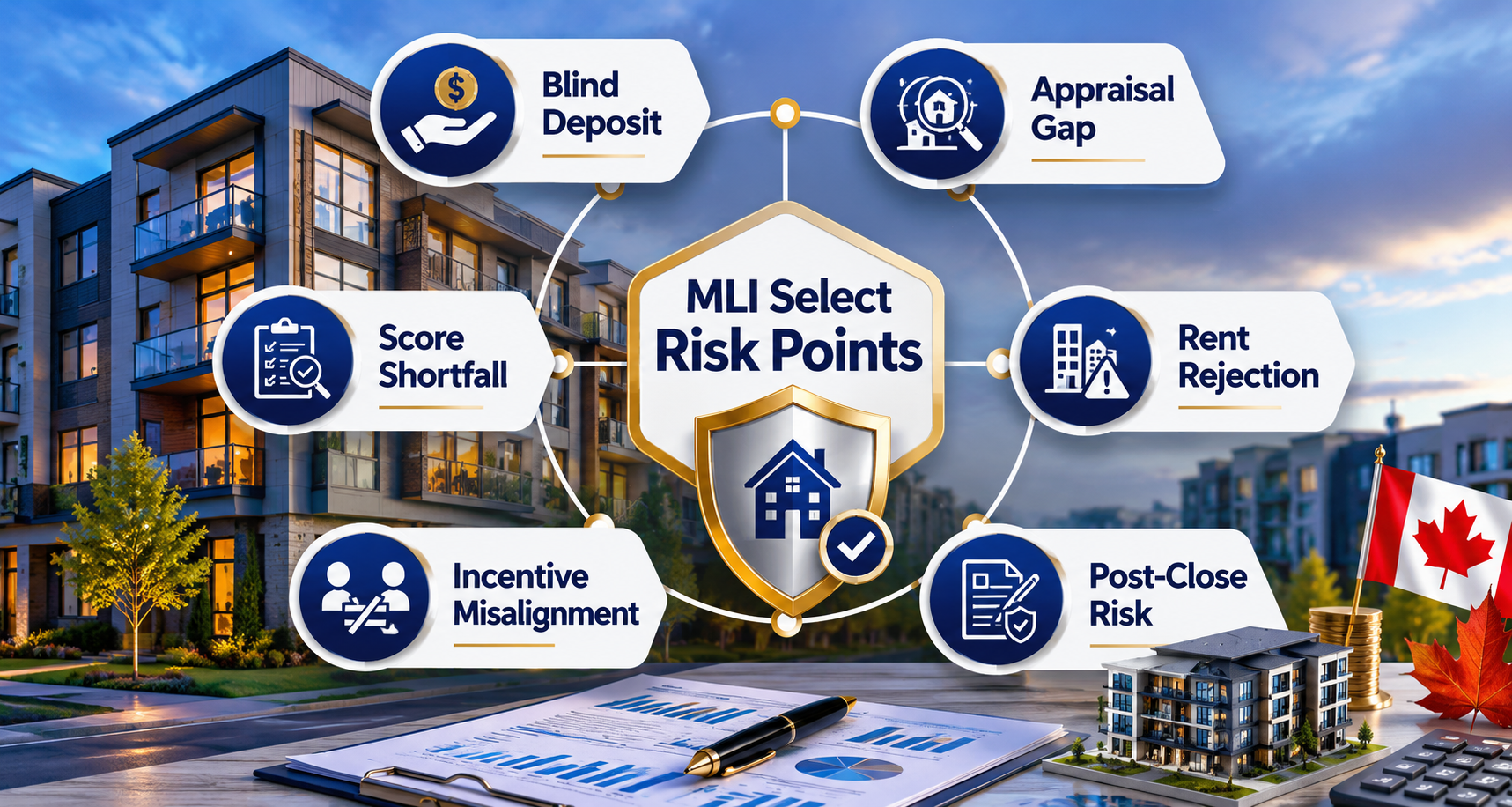
Before diving into the specific scenarios, here is a map of where deals most commonly go wrong — and whether each risk is preventable with the right deal structure in place from the start:
| Risk Type | When It Strikes | Who It Affects Most | Preventable? |
|---|---|---|---|
| Blind 5% Deposit | Before financing is confirmed | All first-time MLI Select buyers | Yes — refundable deposit + due diligence first |
| Appraisal Gap | After deposit is placed | Buyers who skip independent appraisal | Yes — appraisal before commitment |
| Points Score Shortfall | At CMHC documentation review | Buyers who trust brochure over verification | Yes — independent score verification up front |
| Rent Projection Rejection | At financing stage | New construction projects in lease-up | Yes — signed leases or market appraisal only |
| Incentive Misalignment | Throughout the deal — especially late | Buyers whose agent is paid early | Yes — work only with advisors paid at closing |
| Post-Close Abandonment | After closing when issues emerge | Buyers without ongoing advisor relationship | Yes — advisor committed through full completion |
🔗 External Source: CMHC MLI Select — Documentation and Underwriting Requirements
Scenario 1: The 5% Deposit That Was Not Refundable

An investor finds a promising pre-construction multi-unit project. The marketing looks attractive — 95% financing, long amortization, and strong projected rents.
Excited to secure a position, the investor places the standard 5% deposit before independently verifying the appraisal, financing structure, or MLI Select point score.
Months later, the financing comes back weaker than expected. The appraisal is lower, the score is reduced, and the deal suddenly requires significantly more capital than planned.
What Went Wrong?
The investor committed capital before verifying the appraisal, financing terms, and CMHC qualification.
The Lesson
Capital should go in last, not first. Verify the deal, confirm financing, then commit meaningful funds.
Scenario 2: The Appraisal Gap Nobody Mentioned Until It Was Too Late
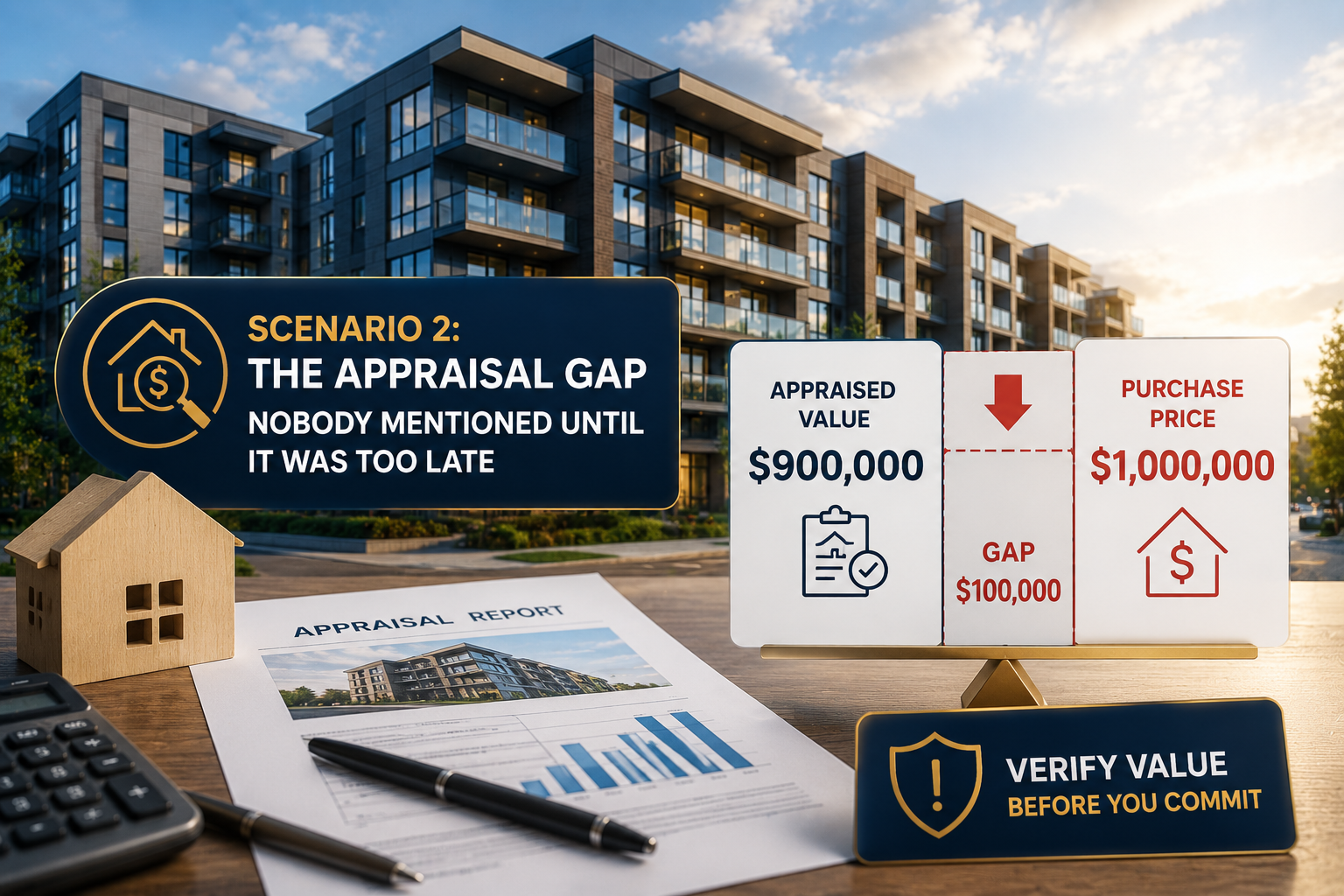
Purchase Agreement Signed
The investor commits to the project based on projected financing benefits.
Deposit Paid First
Capital is committed before independent value verification.
Appraisal Comes In Low
Lender finances against appraised value, not purchase price.
Unexpected Capital Gap
Investor must contribute more equity or risk losing the deposit.
🔴 What Went Wrong?
The appraisal happened after the commitment. Capital was exposed before verifying whether the property’s value supported the purchase price.
✅ The Lesson
Get the appraisal first. When value is verified before deposits become meaningful, appraisal-gap risk is effectively eliminated.
Scenario 3: The Point Score That Existed in the Brochure But Not in the Documentation

📈 Marketed
📉 Reality
🔴 What Went Wrong?
The advertised score was never independently verified against actual CMHC documentation requirements.
✅ The Lesson
Verify the score before committing capital. Marketing claims and documented CMHC eligibility are not always the same.
Janak’s Insight
This is the most MLI-Select-specific trap in the series — and the one that catches the most experienced investors off guard. Janak Singh Chhabra independently verifies that the point score on every project he brings to clients is genuine, documented and defensible under CMHC review. Not because he doubts every developer. But because he has seen what happens when the verification gets skipped.
Scenario 4: The Rent Projections That CMHC Would Not Accept

- Projected rents used
- Strong DSCR on paper
- Financing appears approved
- Investor proceeds confidently
- Projected rents not accepted
- Income adjusted downward
- DSCR falls below target
- Financing terms weaken
🔴 What Went Wrong?
The financing model relied on projected rents that could not be supported by signed leases or a market rent appraisal.
✅ The Lesson
Build financing models using market-supported income only. Signed leases and formal rent appraisals are what CMHC recognizes during underwriting.
🔗 External Source: CMHC Underwriting Criteria — Multi-Unit Residential
Scenario 5: The Advisor Who Was Paid Before the Deal Closed

- Quick responses
- Frequent communication
- Project enthusiasm
- Strong availability
- Encouragement to proceed
- Delayed responses
- Reduced follow-up
- Financing issues emerge
- Project delays appear
- Investor left unsupported
🔴 What Went Wrong?
The advisor was effectively compensated when the deposit was placed, not when the transaction successfully closed.
✅ The Lesson
Work with advisors whose compensation depends on a successful closing. Aligned incentives create long-term accountability.
What Is the Single Thread Connecting Every One of These Risk Scenarios?
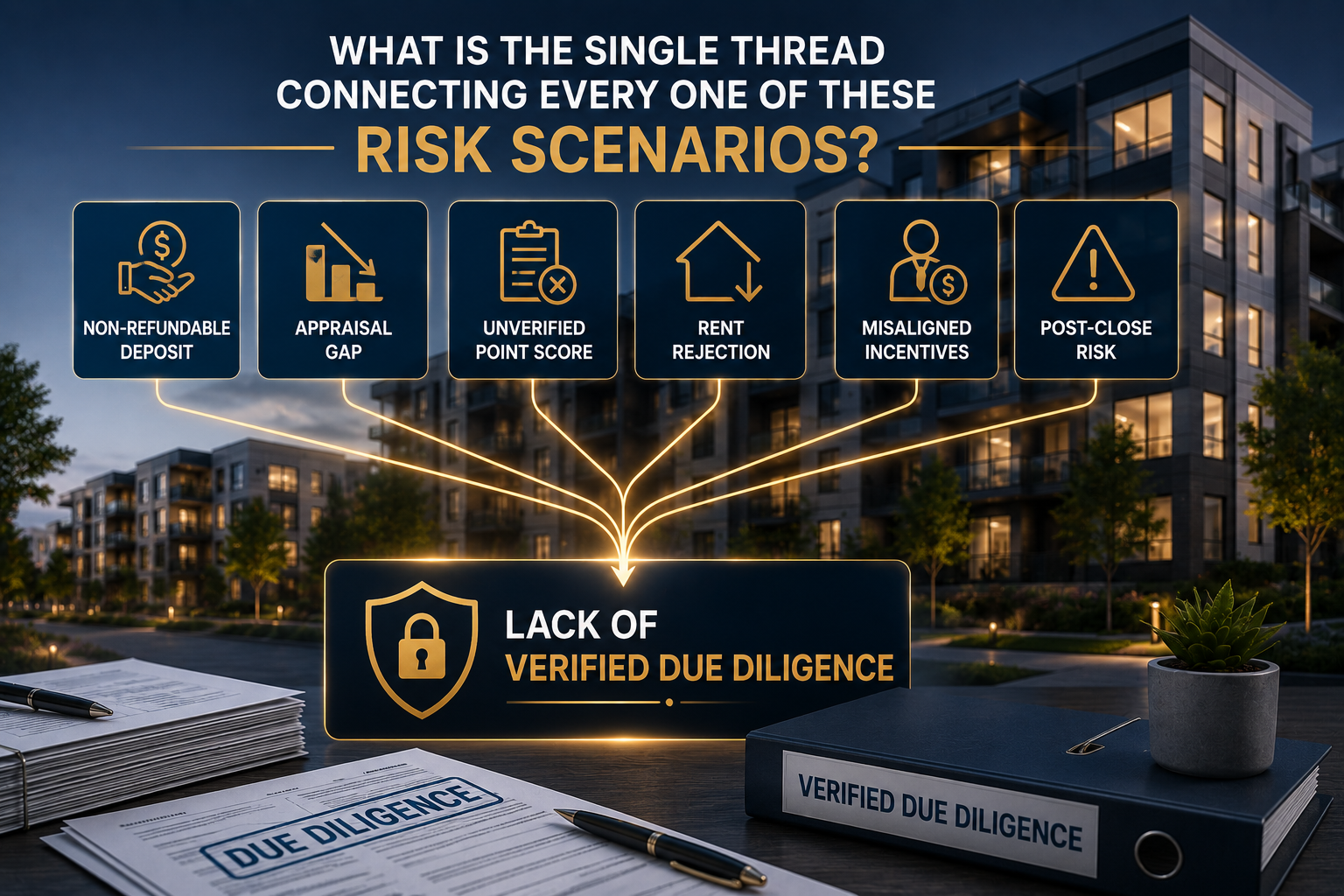
Read through those five scenarios again and notice what is absent from every one of them: the building. Not one of these situations was caused by the property being in the wrong location, having structural problems or generating insufficient rents. The building was fine in every case.
Every failure happened at a process stage — at financing, at documentation review, at the appraisal, at the closing table, or in the advisor relationship. And every failure was preventable by applying the right structure in the right sequence before capital was at risk.
This is what separates a well-structured MLI Select deal from a poorly structured one. Not the property. The process. And the process is entirely within the investor’s control — if they know what to look for and who to work with.
How Does Janak Singh Chhabra's Deal Structure Protect Investors From Each of These Risk Points?

The scenarios above are not abstract concerns. They are patterns that come up repeatedly in MLI Select transactions — and they are the reason Janak Singh Chhabra built his entire client process around protecting buyers at the specific stages where these failures occur. Here is how each risk point is addressed:
| Risk Stage | What Can Go Wrong | How Janak Singh Chhabra’s Structure Protects You |
|---|---|---|
| Initial Commitment | Full 5% deposit at risk before the deal is verified | $5,000 fully refundable deposit + two-week due-diligence window first |
| Appraisal Gap | Appraisal comes in below purchase price after deposit is placed | Appraisal happens before any meaningful deposit — gap identified before commitment |
| Points Score Gap | Project scores lower than marketed — promised terms shrink | Janak Singh Chhabra verifies the score is genuine and documented before capital is at risk |
| Rent Documentation | Projected rents rejected by CMHC — financing weakened | Only market-supported or signed-lease income is used in projections — no assumptions |
| Advisor Misalignment | Agent paid on advance commission disappears before closing | Janak Singh Chhabra is paid only at final closing — incentives aligned start to finish |
| Post-Purchase Issues | Problems surface after closing with no advisor available | Pre- and post-purchase service through to a successful close — answers the phone when needed |
The structure is not complicated. It is simply the right order of operations — informed by experience with where MLI Select deals actually break and designed to ensure the investor’s capital is never at risk before the deal is verified. The investor who follows this process does not need luck. They need the right sequence.
What Should Every Investor Do Before Committing Capital to an MLI Select Project?
The program is powerful. The financial benefits are real. A well-structured MLI Select deal in a strong market like Edmonton can genuinely transform a multi-unit investment’s monthly cash flow, leverage and long-term performance in ways that conventional financing cannot match.
But the program is also complex, document-heavy and full of stages where things can go wrong quietly — without the investor realising it until the moment they are asked to cover a gap they were never told existed, or to commit more capital than they had budgeted, or to walk away from a deposit they cannot recover.
The right protection against all of that is not more research on the property. It is the right advisor, the right deal structure and the right sequence of steps — one that keeps your capital protected through every stage between your first conversation and your keys.

Before You Put a Single Dollar at Risk on an MLI Select Project — Have This Conversation First.
Janak Singh Chhabra specializes in MLI Select and structures every deal to keep your deposit safe through the stages where others lose theirs. Refundable to start. Appraisal before you commit. Only 1% once the value checks out. Paid only when your deal closes.
mliselectprojects.ca · TFN Realty Inc., Brokerage · Maxwell Polaris, Brokerage
WHY INVESTORS WORK WITH JANAK SINGH CHHABRA
Avoid costly MLI Select mistakes.
MLI Select isn’t a program you want to learn on the job. The biggest mistakes often happen long before closing — during project selection, financing structure, appraisal review, and deposit planning. Janak Singh Chhabra specializes in MLI Select opportunities and helps investors navigate every stage with a process designed to protect capital and reduce risk.
Every recommendation is built around long-term cash flow, financing efficiency, and protecting the investor from common pitfalls that many buyers only discover after they have already committed funds.
INVESTOR-FIRST APPROACH
$5,000
Initial Fully-Refundable Deposit
1%
Due-Diligence & Verification Period
2 Weeks
Commission Paid Only At Final Closing
100%
Directional illustration only. Project-specific economics shared privately.
Frequently Asked Questions
Is losing a deposit on an MLI Select deal actually common?
Deposit loss is not inevitable — but it is more common than most investors expect, precisely because the risk points in MLI Select are not visible to buyers who are focused on the property rather than the process. The scenarios in this article represent patterns that come up regularly in multi-unit pre-construction transactions, not rare edge cases. The good news is that every one of these risk points is preventable with the right deal structure from the start.
What is a fully-refundable deposit structure and how does it protect an investor?
A fully-refundable deposit structure means the initial amount placed to hold a position in a project is returned in full if the investor decides not to proceed — typically within a defined due-diligence window. It allows the investor to begin the verification process (appraisal, score review, financing assessment) before any meaningful capital is at risk. If the deal does not check out during the due-diligence window, the investor walks away with their capital intact. Janak Singh Chhabra starts every deal this way — with a $5,000 refundable deposit and a two-week due-diligence window before any larger commitment is made.
How can I independently verify that an MLI Select project actually scores at the tier it claims?
Independent score verification means reviewing the actual project documentation against CMHC’s published scoring requirements — not the developer’s marketing materials. This includes confirming that energy modelling was properly commissioned by a qualified energy modeller at the design stage, that affordability commitments are formally attested and documented and that accessibility standards reference the correct CMHC-accepted standard. An advisor who specialises in MLI Select and has processed these deals through CMHC’s underwriting review knows exactly what the documentation needs to look like — and what gaps indicate a claimed score that will not survive CMHC review.
Why does CMHC no longer accept projected rents for multi-unit financing during lease-up?
CMHC’s shift away from projected rents reflects a broader underwriting discipline: income used to qualify a loan must be supportable by documented evidence, not assumptions. Projected rents during lease-up represent the developer’s best estimate of what units will rent for — but they have not been tested against actual market demand. CMHC’s current guidance requires either signed lease agreements showing actual rents or a formal market rent appraisal by a qualified appraiser. For investors in new construction projects still in lease-up, this means the financing calculation must be based on actual market data rather than the developer’s projections.
How do I know if my real estate agent is being paid on an advance commission basis?
The agent’s compensation structure is something you can ask directly — and should. An agent paid on advance commission receives their fee when your deposit goes down, meaning they are financially whole before your deal is closed and protected. An agent paid only at final closing has a financial incentive to stay engaged and solve problems all the way to completion. Ask your advisor directly: ‘When do you receive your commission — at deposit or at closing?’ The answer tells you everything about their incentive structure.
What should I do if a developer refuses to offer a refundable deposit structure?
Some developer programs do not offer fully refundable deposit structures as a standard offer. If the developer will not negotiate a refundable deposit or a due-diligence window, that itself is a risk signal worth weighing. It means you are being asked to commit capital before verification — which is the structure that produces the scenarios described in this article. Work with your advisor to understand whether the deal’s merits justify that risk or whether a different project with a better structure is the right choice.
Does working with Janak Singh Chhabra guarantee that my MLI Select deal will close successfully?
No advisor can guarantee that any real estate deal will close — there are factors outside any professional’s control. What Janak Singh Chhabra’s structure does is remove the preventable risks: the blind deposit, the appraisal gap, the unverified point score, the projected-rent trap and the incentive misalignment. By addressing each of these structural risks before capital is committed, the process dramatically reduces the likelihood of the most common ways MLI Select deals fail — and keeps Janak Singh Chhabra’s interests fully aligned with yours through every stage to closing.
If the program has these risks, why is MLI Select still worth pursuing?
The risks described in this article are not arguments against MLI Select. They are arguments for going into it correctly. The program itself delivers genuine, government-backed advantages that no conventional financing product can match — higher leverage, longer amortizations, stronger cash flow and a structure built for long-term rental wealth. The investors who get hurt are the ones who pursue those benefits without understanding the process risks. The investors who do well are the ones who access the same program through a deal structure that protects them at every stage where others lose their deposit.

Janak Singh Chhabra
A licensed Realtor at TFN Realty Inc., Brokerage – and one of the few specialists in Canada who works exclusively at the intersection of pre-construction real estate and CMHC MLI Select multi-unit investments. Janak is a two-time Diamond Award winner at Bay Street Group — one of the most recognized performance awards in Canadian real estate — for 2023 and 2024. The Diamond Award is given to top-performing realtors who demonstrate exceptional results across transaction volume, client satisfaction and professional excellence.