
What Edmonton's Investment Boom Means for the Real Estate Market — And Why It Makes CMHC MLI Select Projects Even More Viable

Table of Contents
Listen to this Article
Listen to the complete guide while you continue reading.
Money moves toward opportunity. Right now, a remarkable amount of it is moving toward Edmonton.
Global companies are committing billions to the region, and people are following the jobs. For real estate investors, that combination — big capital plus rising population — is one of the clearest long-term signals there is. It is also the reason CMHC MLI Select projects in Edmonton look stronger today than they did even a year ago.
Let us walk through what the investment actually does to the market, and why it strengthens the case for multi-unit rental deals.
The capital is already arriving
The headline commitments are hard to overstate. Meta is building a data centre worth more than $13 billion just north of Edmonton — one of the largest private-sector investments in Canadian history. Dow’s roughly $10-billion net-zero complex is underway in the Industrial Heartland near Fort Saskatchewan. Behind them sits a wider cluster of AI, hydrogen, and logistics projects adding up to well over $100 billion in committed and proposed capital.
(For a full breakdown of these projects, see our companion article on [why Edmonton leads Canada for CMHC-backed real estate].)
The point for this article is simpler: this is not one lucky announcement. It is a sustained, multi-year wave of employment landing in one region.

What a wave of investment does to a real estate market
Big investment follows a chain reaction that shows up in property values over time:
- Projects create jobs — thousands during construction, then permanent roles once operations begin.
- Jobs attract people — workers move in, and so do the suppliers and service businesses around them.
- People form households — and every household needs a place to live, to buy or to rent.
- Demand absorbs supply — new units fill, older units stay occupied, and pressure builds on rents and prices.
- Land and replacement costs rise — which quietly lifts the value of the buildings already standing.
This is how a modest industrial announcement in one county ends up supporting rents in a neighbourhood twenty minutes away. The effect is not instant, but it is durable.
The proof it is already happening: people are moving in

You do not have to take the theory on faith. The migration numbers are already among the strongest in the country.
- Edmonton’s metro area population grew 3.0% in the year to July 2025 — the largest growth rate of any major census metro area in Canada.
- Edmonton overtook Calgary as the city with the largest net interprovincial migration surplus in the country, at roughly +11,742 people — while Toronto recorded the worst result of any major city, losing about 12,700 to other provinces.
- Over four years, the Edmonton region grew close to 15%.
Why here? A mix that is hard to beat: relative affordability, real job opportunity, and no provincial sales tax. Increasingly, Canadians are voting with their feet, and Edmonton is where many are landing.
An honest word on the current cycle
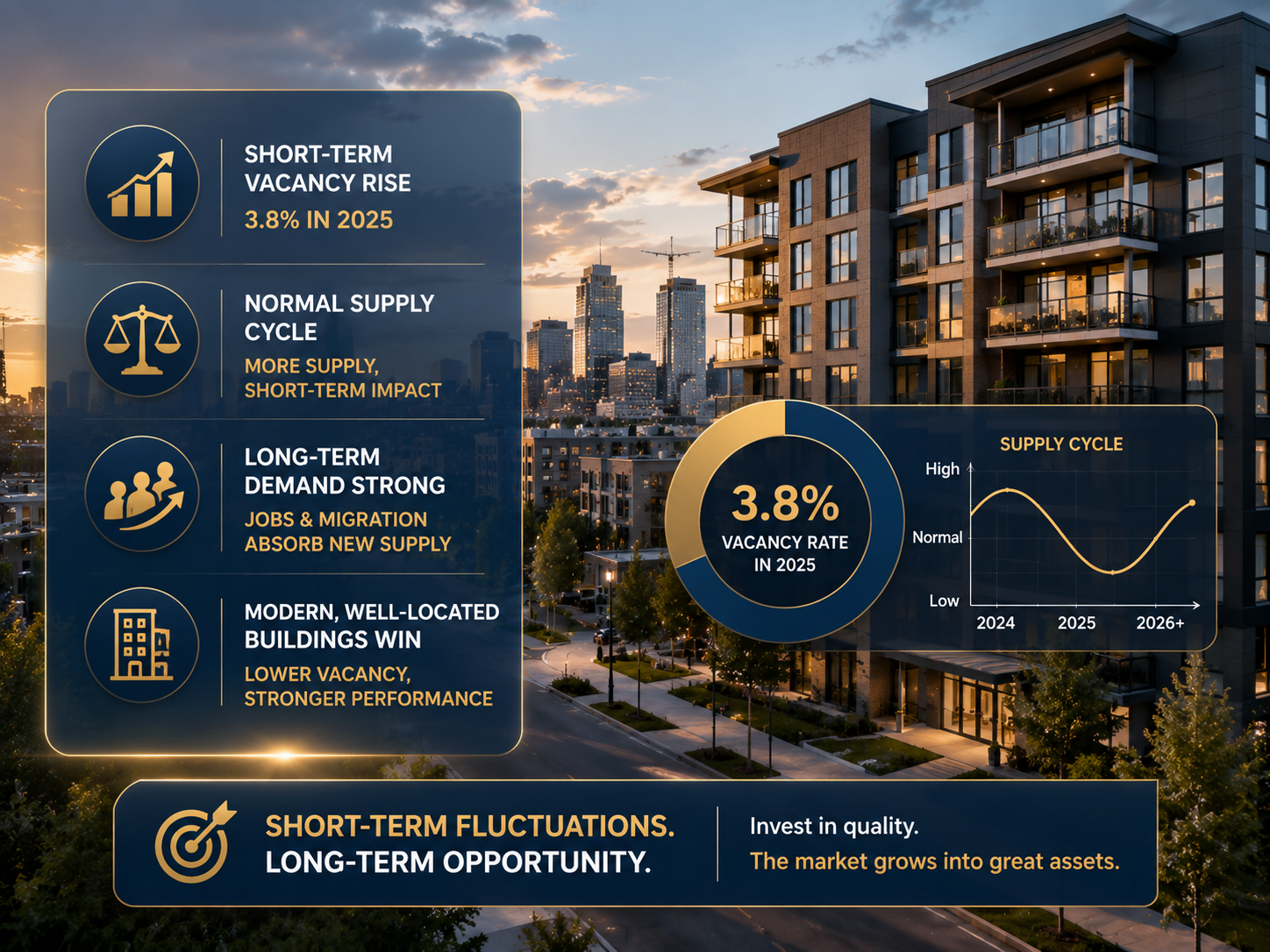
In 2026, Edmonton’s purpose-built rental vacancy rose to about 3.8%, because builders delivered a large amount of new supply at once while short-term demand cooled. That is a normal supply cycle. What matters for an investor is what absorbs that supply — and a multi-year wave of jobs and migration is exactly the force that does. Buying into the absorption is the opportunity. It is also why the newest, best-located buildings tend to win: vacancy for modern apartment units stayed low even as the broader rate rose.
Why this makes CMHC MLI Select projects even more viable
A CMHC MLI Select deal ultimately rests on two questions. Does the building cash-flow after debt service? And will it hold and grow its value? A growing, job-rich, in-migration-leading market improves both answers.
Stronger, more durable rent support. More people competing for housing supports rents over the life of your hold. Combined with Alberta’s lack of rent control — which lets you reset rents to market at turnover — that protects your net operating income and your debt-coverage ratio as costs and rates move.
Appreciation on top of cash flow. In a market with rising land and replacement costs, a well-located building tends to gain value over time. That is equity growth layered on top of the monthly cash flow the project already produces.
You are building what the city actually needs. Edmonton needs more quality rental housing to house its incoming workforce. MLI Select is designed to finance exactly that. So instead of fighting the market, an MLI Select investor is supplying what it is short on — which is the best long-term protection against vacancy there is.
New construction buys you time. A brand-new building carries no major capital costs for 15 to 20 years. That lets the market grow into your rents while you avoid the roof, window, and HVAC bills that drag down older properties.
Put together: a market pulling people in, rents that can move with it, values supported by rising costs, and a financing program built for the exact housing the region needs. That is what “more viable” looks like in practice.
The takeaway
Edmonton’s investment boom is not just a business-news story. It is a demand engine for housing, and it strengthens the case for well-structured, brand-new multi-unit rental projects.
The next step is to look at the actual buildings and run the numbers. Each project comes with a one-page investor proforma showing income, expenses, financing, and projected returns.
Ready to see what is available? Call Janak Singh Chhabra at (647) 999-0935 or request the current project package through the contact page.
No fee. No pressure. Just a conversation.
Frequently Asked Questions About MLI Select Rates
Is Edmonton's real estate market growing in 2026?
Edmonton leads major Canadian cities in population growth and interprovincial migration, backed by billions in new investment. Those are strong long-term demand signals, though every property should be judged on its own numbers.
How does population growth affect rental property investors?
More people means more households competing for housing. Over time, that supports occupancy and rents, which are the two things that keep a rental investment healthy.
Why does Edmonton's investment boom help MLI Select deals specifically?
MLI Select projects depend on cash flow and long-term value. A growing, job-rich market supports rents (helping cash flow) and property values (building equity), while the program finances the exact rental housing the region needs.
Doesn't new supply hurt my investment?
New supply can raise vacancy in the short term, as it did in 2025. But a sustained wave of jobs and migration is what absorbs that supply. Well-located, modern buildings tend to lease first and hold tenants longest.

Janak Singh Chhabra
A licensed Realtor at TFN Realty Inc., Brokerage – and one of the few specialists in Canada who works exclusively at the intersection of pre-construction real estate and CMHC MLI Select multi-unit investments. Janak is a two-time Diamond Award winner at Bay Street Group — one of the most recognized performance awards in Canadian real estate — for 2023 and 2024. The Diamond Award is given to top-performing realtors who demonstrate exceptional results across transaction volume, client satisfaction and professional excellence.
Janak Singh Chhabra is a licensed real estate representative, not a mortgage broker or financial advisor. Market data is drawn from public sources including Statistics Canada and CMHC and is subject to change. All investment figures are estimates for illustration. Buyers should verify financing with a qualified mortgage professional and complete independent due diligence before purchasing. E.&O.E.