
Am I Eligible for CMHC MLI Select?Qualification Requirements Explained for Canadian Investors

Table of Contents
Why Do So Many Investors Walk Away From MLI Select Before They Even Check If They Qualify?
It happens more often than it should. An investor hears about CMHC MLI Select — the higher leverage, the longer amortizations, the stronger cash flow — and gets genuinely interested. Then they read something technical, talk to someone who gives them a vague answer or assume the program is only for large developers with deep pockets. And they walk away from the best multi-unit financing tool available in Canada without ever properly checking whether they qualify.
That assumption is expensive. Not in the sense of money lost — but in opportunity missed. Many investors who believe they are too small, too inexperienced or too early in their journey would qualify for MLI Select if they simply understood what the program actually requires.
Eligibility for MLI Select is not primarily about who you are. It is about what your project commits to. The scoring system rewards commitment — to affordability, to energy efficiency and to accessibility — not investor pedigree or net worth. A first-time multi-unit investor with the right project structure can qualify as legitimately as an institution with hundreds of units under management.
The real question is not whether you are good enough for MLI Select. The real question is whether your project is designed to score enough points — and whether you understand what that design requires before the plans are finalized.
📎 Related Read: New to MLI Select? Start with the full beginner’s guide
What Is the Single Non-Negotiable Starting Point for CMHC MLI Select Eligibility?

Before any points are counted and before any financing terms are discussed, there is one requirement that cannot be worked around: the property must be a multi-unit residential rental building with a minimum of five self-contained units.
This is not negotiable. A single-family home does not qualify. A duplex does not qualify. A triplex or fourplex does not qualify. MLI Select is a program for multi-unit residential rental — specifically properties with five or more units where the purpose is generating income from long-term tenants, not personal use or short-term rental.
Both new construction and existing buildings can qualify. A purpose-built new apartment development qualifies. An existing apartment building being purchased or refinanced qualifies. Certain conversion projects — where a non-residential building is being converted to residential rental use — may also qualify, subject to CMHC’s assessment of the specific project.
Once the five-unit threshold is confirmed, the eligibility question shifts from the property type to the point score — because that is where the actual financing terms are determined.
How Does the MLI Select Points System Determine Whether Your Project Qualifies?

MLI Select does not offer one fixed set of terms to all qualifying projects. It uses a tiered points system where your project earns points by committing to housing goals across three categories. The more your project commits — and the more deeply it commits — the higher your score and the stronger your financing terms.
To access any enhanced MLI Select benefit, your project must earn a minimum of 50 points. Beyond that floor, there are three tiers. Here is how the tiers map to financing outcomes:
| Tier | Points Required | Premium Discount | Max Amortization | Typical Path |
|---|---|---|---|---|
| Standard | 50+ Points | 10% | 40 Years | Single pillar — affordability or energy alone |
| Enhanced | 70+ Points | 20% | 45 Years | Two pillars combined — most common approach |
| Maximum | 100+ Points | 30% | 50 Years | All three pillars — requires early design commitment |
🔗 External Source: CMHC MLI Select — Eligibility and Points Overview
What Are the Three Pillars of MLI Select Scoring and What Does Each One Require?
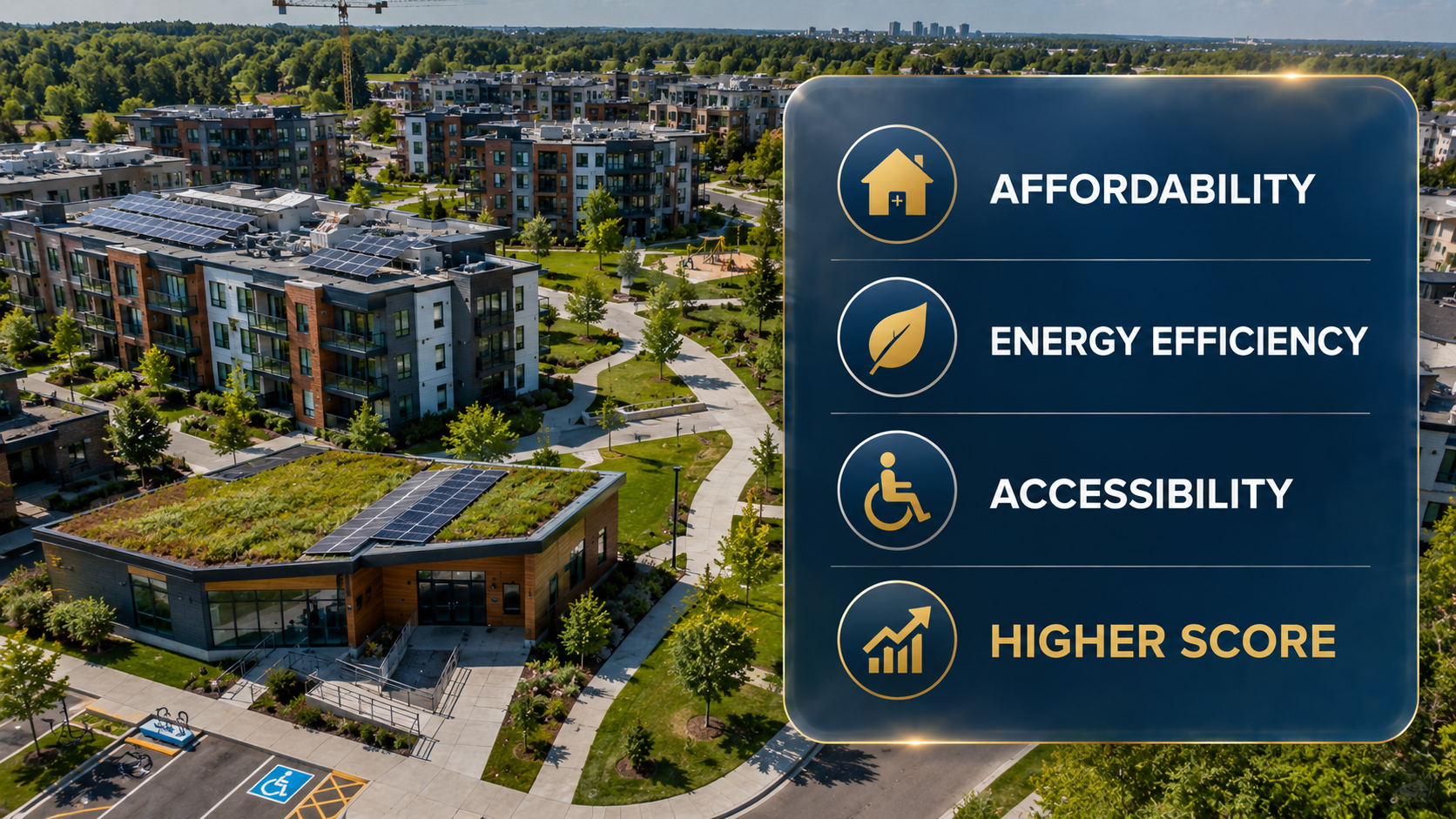
Your project earns points across three categories — affordability, energy efficiency and accessibility. You are not required to hit all three. A project can qualify on a single pillar. But combining categories is the standard path to the Enhanced and Maximum tiers where the strongest financing terms are unlocked. Here is a plain-language breakdown of each pillar and what it requires for both new construction and existing buildings:
| Pillar | What You Commit To | New Construction Thresholds | Existing Building Thresholds |
|---|---|---|---|
| Affordability | Keep a share of units below median renter income rent for a set period. |
Standard: ~10% of units Enhanced: ~15% of units Maximum: ~25% of units |
Standard: ~40% of units Enhanced: ~60% of units Maximum: ~80% of units |
| Energy Efficiency | Build or retrofit to outperform the national energy code baseline. |
Standard: ~20% better Enhanced: ~25% better Maximum: ~40% better |
Standard: ~25% reduction Enhanced: ~35% reduction Maximum: ~50% reduction |
| Accessibility | Design units and common areas to recognized barrier-free standards. | All units visitable + common areas barrier-free | All units visitable + common areas barrier-free |
A Note on the September 30, 2026 Energy Code Deadline
For new construction projects, the energy efficiency pillar is scored against a reference energy standard. Before September 30, 2026, that reference is the older National Energy Code. After that date, new-construction projects are scored against the tougher 2020 National Building Code and 2020 National Energy Code references. Projects filed before that deadline can score energy points more easily — which matters enormously for whether a project reaches the 70 or 100 point tier. For any project currently in design, this deadline is a material strategic consideration.
What Do Lenders Check Beyond the Point Score When Assessing MLI Select Eligibility?

Reaching the minimum point score makes your project eligible for MLI Select — but the lender also conducts its own underwriting assessment before the loan is approved. The point score determines what CMHC will insure. The lender determines whether they will fund. These are two related but distinct steps, and both must be satisfied.
Lenders typically assess the following alongside the CMHC point scoring:
Debt Service Coverage Ratio
The property must generate enough rental income to cover its debt payments with an adequate margin. MLI Select allows a minimum DSCR of 1.10 — lower than the 1.20 required on standard insured loans — which expands the range of qualifying projects. But the income projections used to calculate DSCR must be based on actual signed leases or supported market appraisals. As of recent CMHC guidance, projected rents during lease-up are no longer accepted — rent support must be documented.
Borrower Profile and Financial Capacity
Lenders look at the borrower's track record in rental housing and their overall financial position. A history of successfully operating rental properties strengthens a file. Adequate equity and liquid reserves to support the project through any lease-up period are expected. First-time multi-unit investors are not automatically disqualified — but they benefit significantly from working with an advisor who can present the file in the strongest possible way.
Code Compliance and Zoning
The project must be lawfully buildable or operable in its specific location. Zoning compliance, building permits and adherence to local codes are baseline requirements. Projects in markets with constrained zoning — where purpose-built rental development is restricted — need to confirm compliance before the MLI Select process begins.
Janak’s Insight
There is a difference between points on paper and points that close. The most common surprise in MLI Select is a project that qualifies in the sales pitch but scores lower once CMHC reviews the real documentation. Energy modelling that was never properly commissioned. Affordability commitments that were described loosely rather than attested formally. Rent projections that CMHC no longer accepts. Janak Singh Chhabra verifies the score is genuine and documentable before your deposit is ever at risk — not after.
Why Does Eligibility Have to Be Confirmed Early and What Happens If You Leave It Too Late?
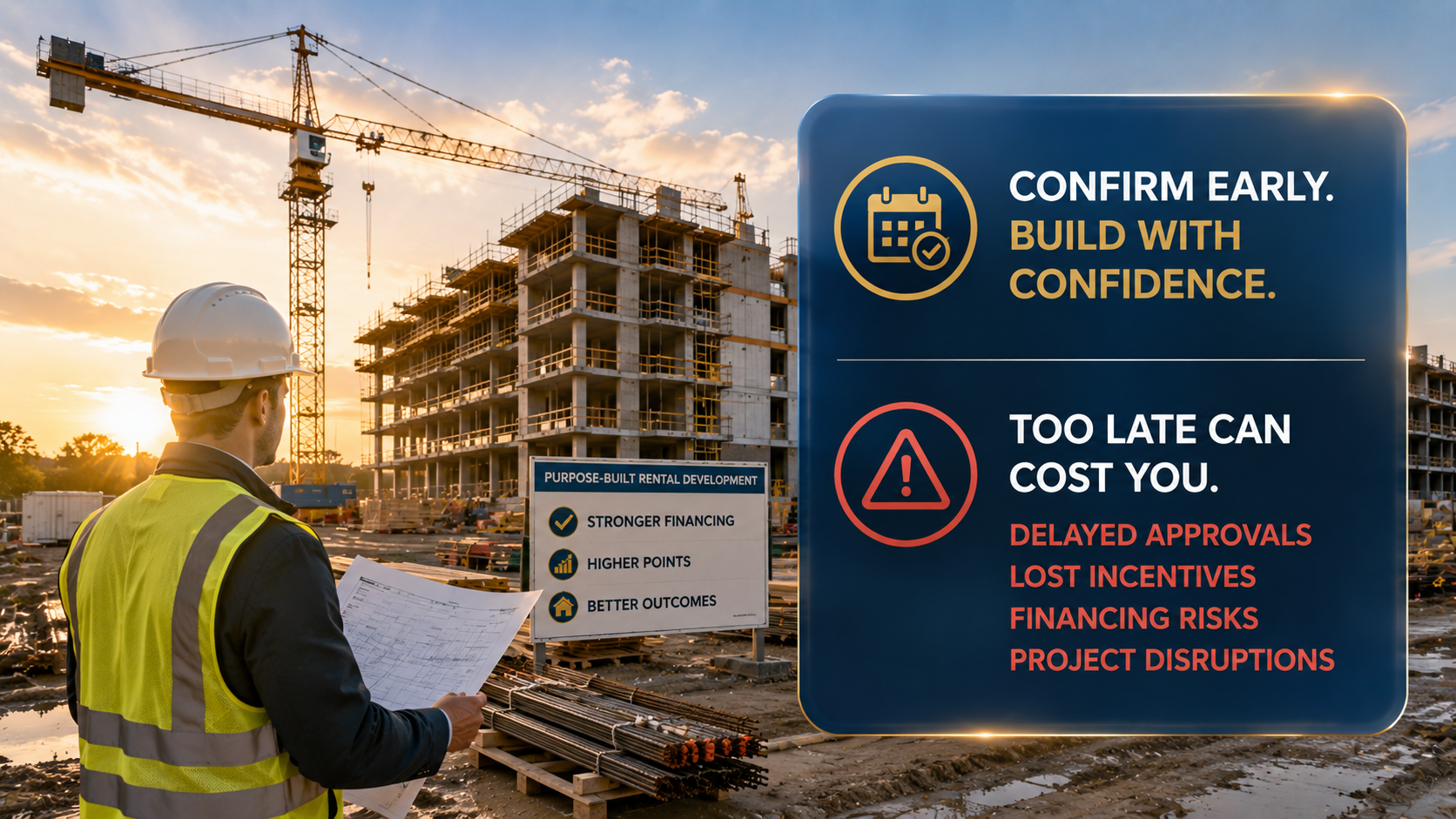
This is the single most important practical lesson in MLI Select eligibility — and the one most investors learn the hard way.
The three scoring pillars are not conditions you can add to a finished project. They are design decisions. Energy modelling must be commissioned at the design stage — it requires the building’s thermal envelope, mechanical systems and orientation to be specified before a realistic energy score can be calculated. Accessibility standards must be built into the unit layouts and common areas from the first draft of the floor plans. Affordability commitments must be structured into the legal agreements before financing is arranged.
An investor who tries to retrofit MLI Select eligibility onto a project that was designed without these considerations faces two problems. First, the changes required may not be feasible or may materially increase construction costs. Second, the score they can reach retroactively is almost always lower than what a project designed for MLI Select from the outset can achieve — which means weaker financing terms and a worse investment outcome.
The investors who score highest and access the best terms are the ones who bring the right advisors into the process before the architectural drawings are finalized. Not after the permit is submitted. Not after the purchase agreement is signed. Before.
Two investors can purchase the same building. The one who accesses it through a well-structured MLI Select deal walks away with lower monthly payments, better cash flow and more capital preserved for future deployment. The property is identical. The financing is not.
Who Is Most Likely to Qualify for CMHC MLI Select and What Profile Does Well?
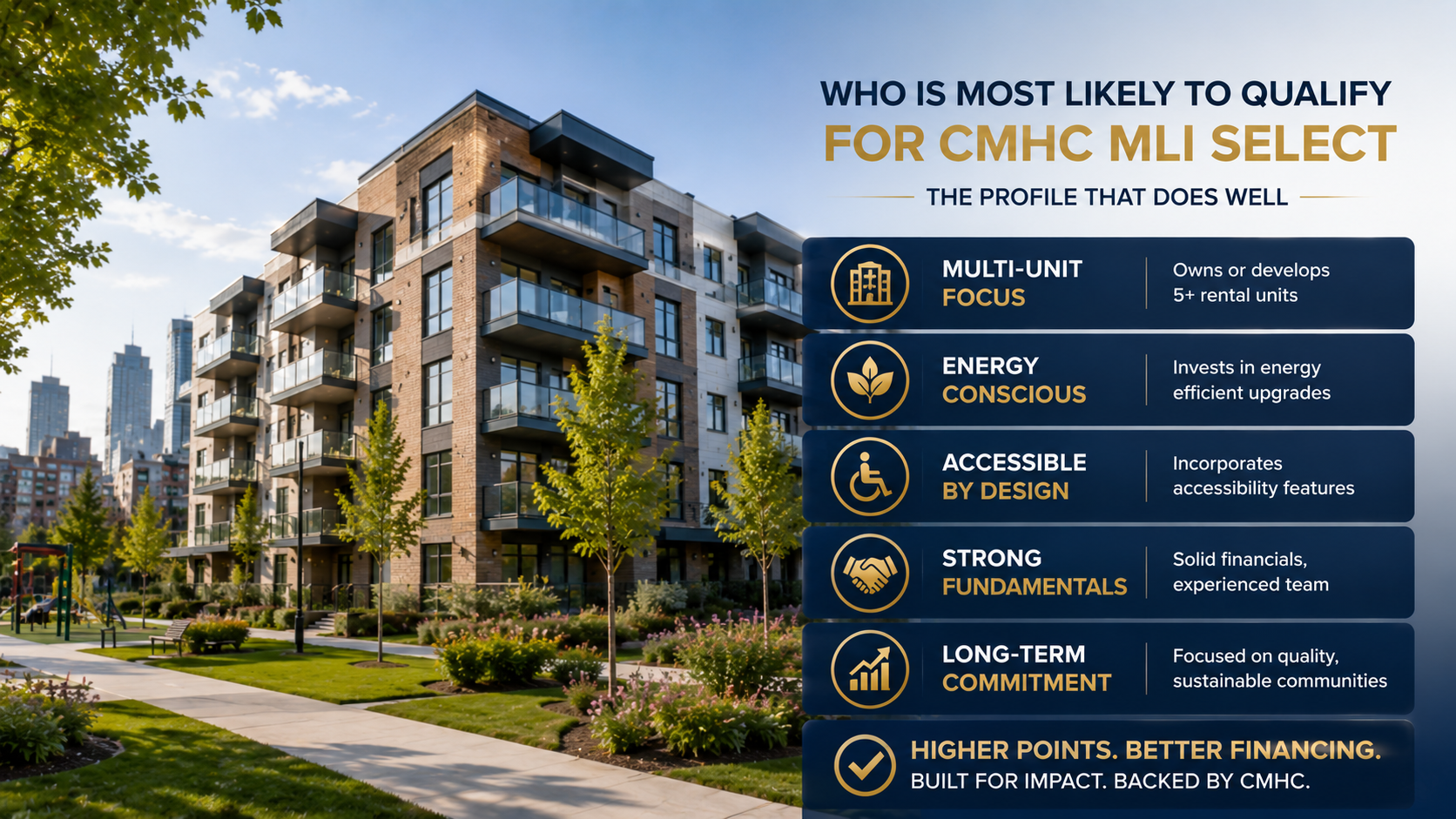
MLI Select is not exclusively for large institutional developers. The program has been successfully used by investors at a range of scales — from a single 6-unit purpose-built rental to large 48-unit developments. What matters is not the size of the investor but the alignment of the project with the program’s scoring requirements.
Profiles that tend to do well:
- Investors entering multi-unit real estate for the first time who are working with a project already pre-structured for MLI Select scoring — where the points have been designed in from the beginning rather than assumed
- Experienced single-family or small multi-unit investors who are ready to step into the five-plus unit category and want to access better financing terms than their existing portfolio generates
- Ontario-based investors looking at Edmonton where lower acquisition costs combine with MLI Select financing to produce stronger returns than the local GTA market currently allows
- Pre-construction investors who are graduating from single-unit condos to multi-unit rental and want a structured financing vehicle for the next stage of their portfolio
The common thread across all of these profiles is working with someone who understands the eligibility requirements and has built them into the deal structure from the start — rather than discovering the scoring requirements after the project is already designed.
What Is the Right Next Step If You Think You Might Qualify for MLI Select?
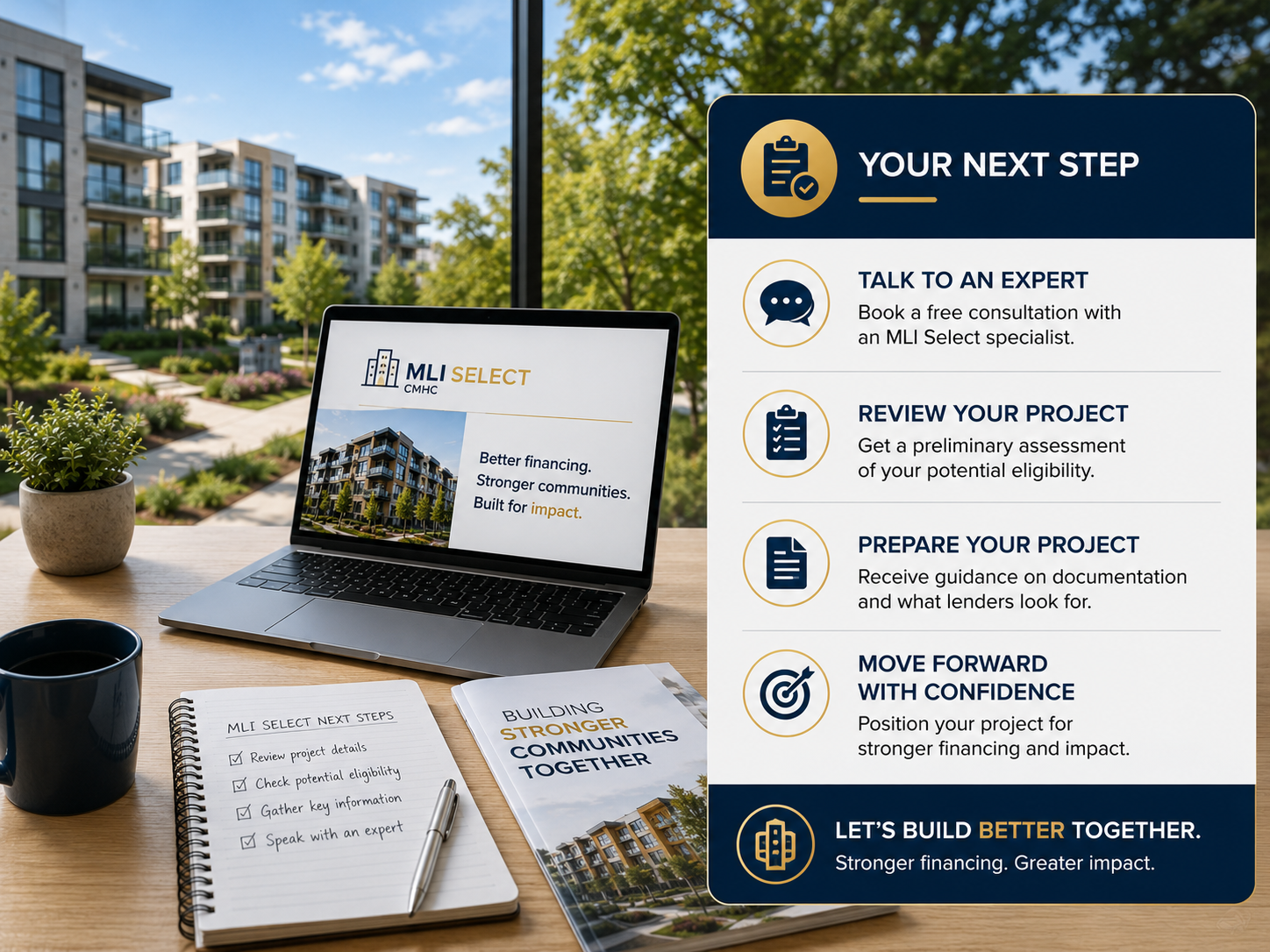
The right next step is a conversation — not a commitment. Understanding whether your project can reach the point tier you need requires looking at the specifics: the property type, the design stage, the market you are buying in and the financing structure that makes sense for your goals.
That conversation is free and it is the most valuable hour you can spend before committing any capital to a multi-unit deal. The alternative — discovering your project’s real score after your deposit is on the table — is a significantly more expensive education.
Not Sure Whether Your Project Qualifies? Let's Find Out Together.
Janak Singh Chhabra maps out a realistic point strategy with you before your deposit is ever at risk. Refundable to start. Appraisal before you commit. Paid only when your deal closes.
mliselectprojects.ca · TFN Realty Inc., Brokerage · Maxwell Polaris, Brokerage
WHY INVESTORS WORK WITH JANAK SINGH CHHABRA
Avoid costly MLI Select mistakes.
MLI Select isn’t a program you want to learn on the job. The biggest mistakes often happen long before closing — during project selection, financing structure, appraisal review, and deposit planning. Janak Singh Chhabra specializes in MLI Select opportunities and helps investors navigate every stage with a process designed to protect capital and reduce risk.
Every recommendation is built around long-term cash flow, financing efficiency, and protecting the investor from common pitfalls that many buyers only discover after they have already committed funds.
INVESTOR-FIRST APPROACH
$5,000
Initial Fully-Refundable Deposit
1%
Due-Diligence & Verification Period
2 Weeks
Commission Paid Only At Final Closing
100%
Directional illustration only. Project-specific economics shared privately.
Frequently Asked Questions
Can a duplex or triplex qualify for CMHC MLI Select?
No. CMHC MLI Select requires a minimum of five self-contained residential rental units. A duplex with two units or a triplex with three units does not meet the program’s property threshold. If you are considering converting a smaller property to reach the five-unit minimum through an addition or conversion, discuss the specifics with a qualified advisor before assuming the project will qualify.
Do I need to be an experienced real estate investor to qualify for MLI Select?
No. There is no minimum experience requirement under the MLI Select program rules. Eligibility is assessed based on the property and its point score across the three pillars — not the investor’s personal track record. That said, lenders conducting their own underwriting will consider your overall financial profile and experience when assessing the full loan application. An experienced advisor helps first-time multi-unit investors present their file in the strongest possible way.
Can an existing apartment building qualify for MLI Select or is it only for new construction?
Both qualify. Existing multi-unit residential rental buildings can access MLI Select financing on purchase or refinance. The scoring thresholds differ from new construction — particularly for affordability, where existing buildings face higher percentage requirements — but the program is explicitly designed to cover both new and existing multi-unit rental. Your advisor and mortgage professional can help determine which pillar is most achievable for a specific existing asset
What happens if my project scores below 50 points?
How does the 2025 premium surcharge affect the value of the amortization benefit?
The surcharge of approximately 0.25% per five-year amortization increment beyond 25 years adds to the base insurance premium. For a 50-year amortization this adds roughly 1.25% to the premium. That surcharge is a one-time cost added to the loan balance, while the benefit of the lower monthly payment runs for the life of the loan. For most long-term holders the cash flow benefit outweighs the one-time surcharge cost — but both need to be modelled honestly to confirm this for a specific deal.
Does the location of the property affect MLI Select eligibility?
CMHC MLI Select is a national program and applies across all provinces and territories. Location does not directly affect eligibility under program rules. However, market-level factors — rental income projections, local zoning requirements and construction costs — affect the debt service coverage calculation and the lender’s underwriting assessment. Markets with stronger rental fundamentals and lower acquisition costs, like Edmonton, tend to produce stronger-qualifying projects because the income and cost structure supports the DSCR requirements more easily.
Why does energy efficiency scoring change after September 30, 2026?
CMHC updated its energy efficiency reference standard in 2024, transitioning to the 2020 National Building Code and 2020 National Energy Code as the scoring baseline for new construction. These standards are more stringent than the older references — meaning new-construction projects filed after September 30, 2026 need to achieve higher energy performance to earn the same number of points. Projects filed before that date can use the older reference, which is a meaningful advantage for projects currently in the design phase.
Can a condo building qualify for CMHC MLI Select?
MLI Select is specifically designed for residential rental housing where units are held for long-term tenants — not for condominiums sold to individual buyers. A purpose-built rental building with five or more units held by a single owner for rental income qualifies. A strata or condo structure where individual units are sold to separate owners does not. If you are exploring pre-construction condos as an investment vehicle separate from MLI Select, that is a different strategy which Janak Singh Chhabra also guides investors through at thenewconstructions.ca.

Janak Singh Chhabra
A licensed Realtor at TFN Realty Inc., Brokerage – and one of the few specialists in Canada who works exclusively at the intersection of pre-construction real estate and CMHC MLI Select multi-unit investments. Janak is a two-time Diamond Award winner at Bay Street Group — one of the most recognized performance awards in Canadian real estate — for 2023 and 2024. The Diamond Award is given to top-performing realtors who demonstrate exceptional results across transaction volume, client satisfaction and professional excellence.