
Cash Flow Real Estate Properties: How to Find and Vet Them in Canada

Table of Contents
Listen to this Article
Listen to the complete guide while you continue reading.
Plenty of listings claim to be “cash-flow positive.” Very few survive a proper check.
A cash flow real estate property is one where the income covers every cost of ownership and still leaves money in your pocket each month. That sounds simple, but a lot of the numbers investors are handed quietly leave things out — and a deal that looks positive on paper turns negative the moment you run it honestly.
This guide shows you how to find cash flow real estate properties in Canada, and exactly how to vet the numbers so you don’t get caught.
What a real cash flow property looks like
True cash flow is what’s left after all of it: the mortgage, property management, a vacancy allowance, property taxes, insurance, and ongoing maintenance and reserves.
If a “cash flow” figure skips any of those, it isn’t cash flow — it’s a marketing number. The first skill you need is the ability to tell the two apart.
Where cash flow properties actually exist
Cash flow is easiest to find where prices are reasonable relative to rents. Two conditions matter most:
- Multi-unit buildings. Several rents under one roof spread the risk and produce more income per dollar invested than a single condo or house. (Here’s [why multi-family cash-flows] when a single condo often doesn’t.)
- Affordable, growing markets. Expensive big cities rarely cash-flow today. Markets with lower entry prices and rising demand do.
Start there, then vet each candidate with the checklist below.

The 5-step vetting checklist
Rebuild the Income Conservatively
Ignore the seller’s optimistic rent. Check what similar units actually rent for, and insist that income be backed by signed leases or a market appraisal — not “projected” rents the building doesn’t yet collect.
Apply a Real Vacancy Allowance
No building is full 100% of the time. Subtract a realistic vacancy figure (commonly around 3–5%). A proforma showing zero vacancy is a red flag.
Add Back Every Operating Expense
This is where fake cash flow hides. Make sure the numbers include property management, property taxes, insurance, repairs and maintenance, and a replacement reserve for big-ticket items down the road.
Stress-Test the Financing
Run the mortgage at a realistic rate and amortization. Then check the debt-service coverage — the net operating income divided by the annual mortgage payment. You want the rent to cover the debt with a comfortable margin, not by a hair.
Ask Who Verified the Numbers
A projection is stronger when someone independent has checked it. On CMHC-financed multi-unit deals, the agency runs its own underwriting and won’t insure a building that fails a minimum debt-coverage test — an outside check working in your favour.
Red flags that fake cash flow
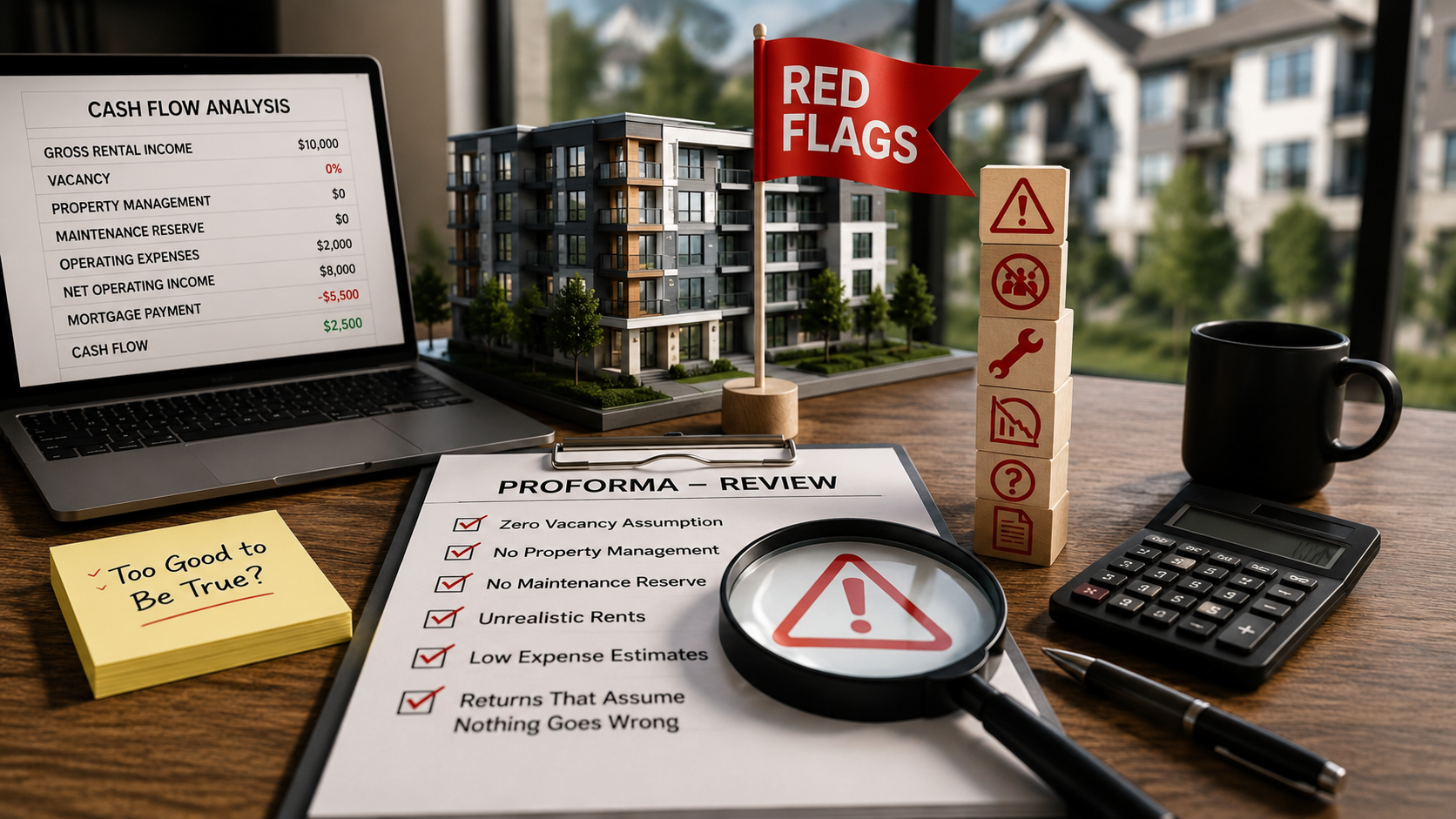
Watch for these when you read any listing or proforma:
- Zero or unrealistically low vacancy.
- No property management line (assuming you’ll do it all for free).
- Missing reserves for future roof, window, or mechanical costs.
- “Projected” or “market potential” rents the building isn’t actually collecting.
- Below-market expense estimates that make the bottom line look better than reality.
- A cap rate or return that only works if nothing ever goes wrong.
Any one of these can flip a “positive” property into a monthly loss.
The fastest shortcut
You don’t have to rebuild every spreadsheet by hand. The quickest way to find genuine cash flow real estate properties is to work from a proper proforma — one that already subtracts real management, vacancy, taxes, insurance, and maintenance, and shows the true cash flow after debt.
Better still, new multi-unit buildings financed through CMHC have already been independently underwritten against conservative benchmarks before financing is approved. That doesn’t remove your responsibility to check — but it stacks the odds in your favour.
Want a property whose cash flow already survives the check? Call Janak Singh Chhabra at (647) 999-0935 or request a proforma through the contact page.
No fee. No pressure. Just a conversation.
Frequently Asked Questions About MLI Select Rates
How do I know if a property is truly cash-flow positive?
Confirm the income is real (signed leases or market rents), a vacancy allowance is applied, and every operating expense — management, taxes, insurance, maintenance, reserves — is subtracted before the mortgage. What’s left is your true cash flow.
What expenses do sellers often leave out?
The most common omissions are property management, a realistic vacancy allowance, and a replacement reserve for major future repairs. Leaving these out inflates the cash-flow figure.
Where are the best cash flow properties in Canada?
In affordable, growing markets and in multi-unit buildings, where several rents spread risk and prices are reasonable relative to income. Expensive big cities rarely cash-flow today.
Is a proforma enough to trust a deal?
A proforma is a strong starting point if it uses conservative, real numbers. On CMHC-financed multi-unit deals, the agency’s own underwriting adds an independent layer of verification, but you should still complete your own due diligence.

Janak Singh Chhabra
A licensed Realtor at TFN Realty Inc., Brokerage – and one of the few specialists in Canada who works exclusively at the intersection of pre-construction real estate and CMHC MLI Select multi-unit investments. Janak is a two-time Diamond Award winner at Bay Street Group — one of the most recognized performance awards in Canadian real estate — for 2023 and 2024. The Diamond Award is given to top-performing realtors who demonstrate exceptional results across transaction volume, client satisfaction and professional excellence.
Janak Singh Chhabra is a licensed real estate representative, not a mortgage broker or financial advisor. Market data and project figures are drawn from public sources and are subject to change. All investment figures are estimates for illustration. Buyers should verify financing with a qualified mortgage professional and complete independent due diligence before purchasing. E.&O.E.