
CMHC MLI Select Benefits Explained:Why Serious Investors Are Paying Attention

Table of Contents
Why Does Good Real Estate Keep Generating Bad Cash Flow for So Many Canadian Investors?
The building looks right. The location makes sense. The rents are reasonable. And yet, month after month, the numbers barely hold — or don’t hold at all. The mortgage payment is too high, the margins are too thin and the investor who did everything right is still waiting for the portfolio to feel like an asset rather than an obligation.
This is one of the most common frustrations in Canadian multi-unit real estate. And the cause, in the majority of cases, is not the property. It is the financing structure sitting underneath it.
Conventional commercial lending was not designed to produce strong cash flow for long-term rental investors. It was designed to limit lender exposure. High down payments, short amortizations and strict debt-coverage requirements all serve the lender’s interest — and they come at a real cost to yours. Every year a loan runs on conventional terms, it runs with a higher monthly payment than it needs to, compressed margins and less breathing room than the property actually deserves.
CMHC MLI Select changes that structure — at the root. Not by making a property seem better than it is but by changing the actual terms under which the loan operates. And those changes cascade through every line of the investment’s performance.
📎 Related Read: New to MLI Select? Start with the full beginner’s guide first
What Makes MLI Select Different From Every Other Financing Tool Available to Canadian Investors?

Most financing improvements in real estate are marginal — a slightly better rate here, a slightly lower fee there. MLI Select is not marginal. It is structural. It changes the fundamental parameters of a multi-unit loan in ways that no conventional product can match because it operates under federal government backing through CMHC.
When CMHC insures a multi-unit loan, the lender’s risk profile changes completely. The loan is no longer measured against the lender’s own capital exposure in the same way. That shift in risk allows lenders to offer terms they simply cannot justify under conventional commercial lending — higher leverage, longer repayment periods and lower cash-flow hurdles. The government’s backing is what creates the space for those terms to exist.
The result is a financing environment that rewards investors who commit to rental housing — and delivers those rewards in the form of real, measurable improvements to every line of the investment equation.
🔗 External Source: CMHC MLI Select Program — Official Program Page
How Does MLI Select Give Investors Access to Higher Leverage Than Conventional Lenders Allow?

Conventional commercial lenders for multi-unit residential properties typically cap their loans at 75–80% of appraised value or purchase price. That ceiling exists because the lender is managing its own exposure without external backing. The investor has to bring the remaining 20–25% or more in equity before the deal even starts.
On a multi-unit project, that equity requirement can represent a very large capital commitment. Many investors find that requirement alone is what keeps them from entering the asset class — or from scaling beyond their first deal.
CMHC MLI Select changes this ceiling materially. Qualifying projects can access financing up to 95% of value or cost. That is not a small difference in percentage — it represents a fundamental shift in how much of your own capital needs to be deployed to control an asset of the same size.
The practical effect: the same capital that might buy you access to one asset under conventional financing can potentially be structured to cover multiple positions under MLI Select. Less capital per deal means more flexibility across your portfolio and a faster path to scale.
How Does a Longer Amortization Through MLI Select Directly Improve Your Monthly Cash Flow?

Amortization is the period over which a loan is repaid. Everything else being equal — same loan amount, same interest rate — a longer amortization produces a lower monthly payment. That lower payment is the direct mechanism through which MLI Select improves cash flow.
Conventional commercial loans are typically capped at 25 years. MLI Select qualifying projects can access amortizations of 40, 45 or 50 years depending on the point tier reached. Here is how that progression translates into cash flow outcomes:
25 Years
Tight or negative cash flow on many deals.
40 Years
Cash flow positive on more projects.
45 Years
Wider monthly margin and greater resilience.
50 Years
Strongest cash flow and maximum investor capacity.
The difference between a 25-year and a 50-year amortization on the same loan amount is not subtle. It is the kind of difference that turns a project that barely clears its costs into one that generates meaningful surplus income every month — and that transforms the investor’s experience from managing a tight position to holding a productive asset.
It is also the reason many Ontario investors who find the GTA market too compressed for strong cash flow are turning to Edmonton where lower acquisition costs and MLI Select amortizations work together to produce yields that simply cannot be replicated under conventional financing.
📎 Related Read: Why Ontario investors are choosing Edmonton for MLI Select deals
What Is the MLI Select Premium Discount and How Much Does It Save You?

CMHC mortgage insurance carries a premium — a one-time cost calculated as a percentage of the insured loan amount that is typically added to the loan balance rather than paid upfront. Under MLI Select, that premium is discounted based on how well your project scores across the three pillars of affordability, energy efficiency and accessibility.
The discount tiers are:
- Standard tier — 50 or more points: 10% discount on the insurance premium
- Enhanced tier — 70 or more points: 20% discount on the insurance premium
- Maximum tier — 100 or more points: 30% discount on the insurance premium
On larger multi-unit projects, these discounts represent real and substantial savings. The premium is already a significant cost on a multi-million dollar loan — reducing it by 20% or 30% removes a meaningful amount from the project’s long-term cost structure.
It is worth noting that as of 2025, CMHC introduced a surcharge for amortizations beyond 25 years — approximately 0.25% per five-year increment. This surcharge partially offsets the premium discount at the longest amortization tiers. A well-structured deal accounts for both the discount and the surcharge in the financial model from the start rather than discovering the net impact later.
Janak’s Insight
Benefits only count if they actually show up at closing. A project can be marketed as 95% LTV with a 50-year amortization — but if the points were never properly modelled, attested and documented, those terms can shrink at the worst possible moment. Janak Singh Chhabra’s job is to make sure the terms you are shown are the terms you actually receive. He verifies the scoring is genuine before your deposit is at risk — not after.
How Does the Lower Debt Service Coverage Requirement Open Up Deals That Conventional Financing Would Reject?

Debt Service Coverage Ratio — DSCR — measures whether a property generates enough rental income to cover its loan payments with an adequate margin. A DSCR of 1.10 means the property earns 10% more than its debt payments. A DSCR of 1.20 means it earns 20% more.
Conventional insured multi-unit loans typically require a minimum DSCR of 1.20. MLI Select reduces that minimum to 1.10 on qualifying projects. That 0.10 difference may sound small but its effect on deal qualification is significant.
Many projects — particularly in markets where acquisition costs are rising faster than rents — fall into the gap between 1.10 and 1.20. They generate enough income to service the debt with a small surplus but not enough to clear a 1.20 threshold. Under conventional financing, those deals do not qualify. Under MLI Select, they do.
For investors, this means access to a broader range of qualifying assets. It means fewer deals falling through at the financing stage. And it means that the combination of higher leverage, longer amortization and a lower coverage requirement can transform a project that would not survive conventional underwriting into one that closes and performs.
Two investors can purchase the same building. The one who accesses it through a well-structured MLI Select deal walks away with lower monthly payments, better cash flow and more capital preserved for future deployment. The property is identical. The financing is not.
🔗 External Source: CMHC Housing Market Outlook — Multi-Unit Rental Trends
What Is the Complete Picture of MLI Select Benefits Side by Side With Conventional Financing?
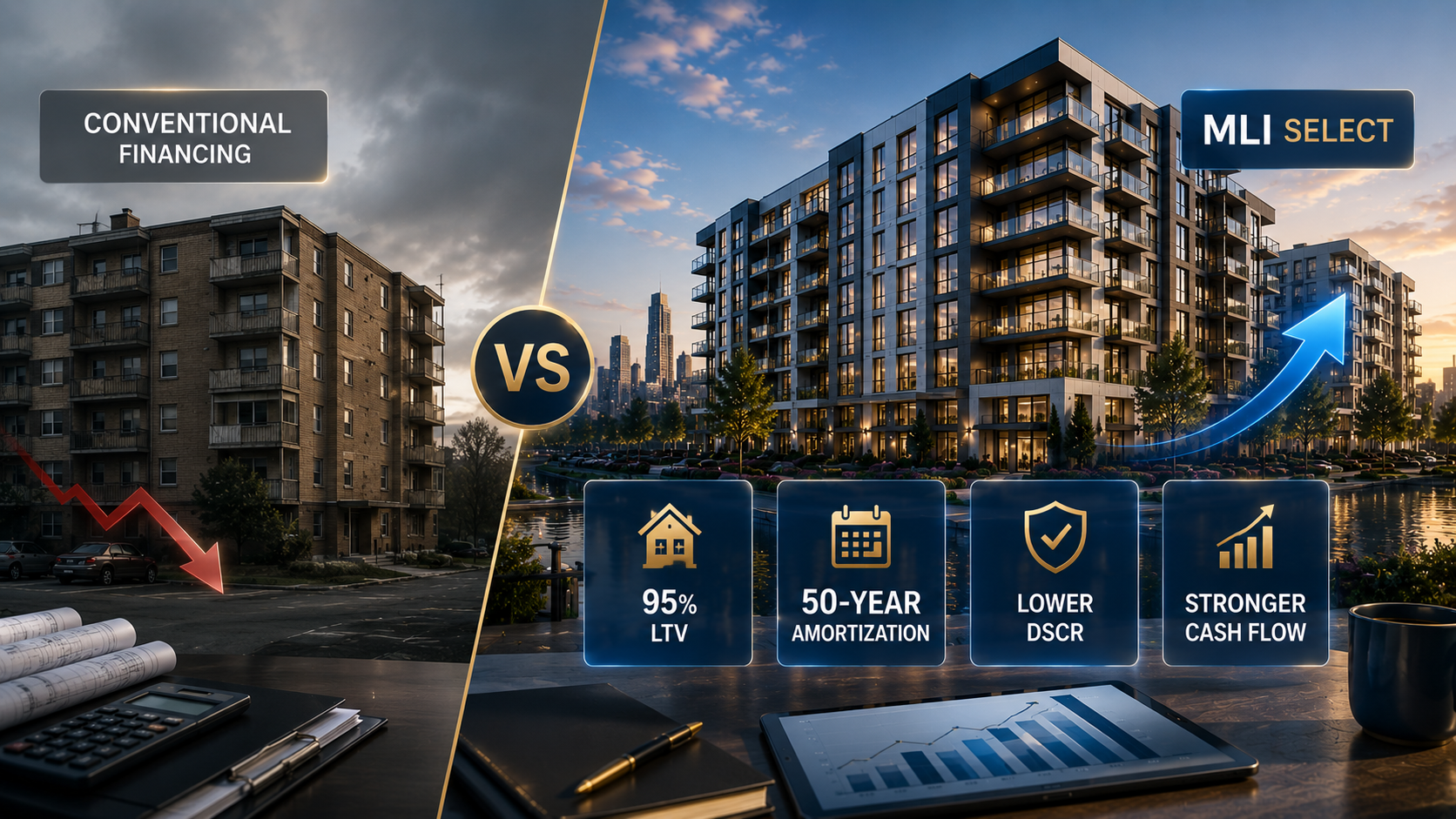
Understanding the benefits individually is useful. Seeing them together is where the full picture becomes clear. Here is a consolidated comparison across every dimension that matters to a long-term rental investor:
| Benefit | Conventional Financing | MLI Select Financing | Why It Matters |
|---|---|---|---|
| Leverage | Up to 75–80% LTV | Up to 95% LTV | Less capital tied up — more left to deploy |
| Amortization | Up to 25 years | Up to 50 years | Lower monthly payments — stronger cash flow |
| Premium Discount | Not applicable | 10% / 20% / 30% by tier | Real savings on insurance costs |
| DSCR Requirement | Minimum 1.20 | Minimum 1.10 | More deals qualify on income alone |
| Government Backing | None | CMHC-Insured | Lender confidence — better terms flow to you |
| Hold Strategy | Short or long term | Optimized for long term | Built for compounding rental wealth |
Are There Any Downsides to MLI Select Benefits That Investors Should Understand?
A responsible discussion of MLI Select includes the commitments that come with the benefits. These are not dealbreakers — they are the terms of exchange that make the program work. Investors who go in with clear eyes do better than those who focus only on the headline numbers.
- Affordability commitments are binding. If your project earns points through affordability — keeping a portion of rents below market — that commitment runs for the agreed period. It is a contractual obligation that affects your income projections over the hold period.
- Energy and accessibility must be designed in early. The points that unlock your financing tier are not added retroactively. Energy modelling happens at the design stage. Accessibility standards are built into the project from the start. Projects that try to retrofit these requirements after plans are finalised score lower and access weaker terms.
- The 2025 premium surcharge is real. Longer amortizations now carry a surcharge that adds to the base premium. The net benefit of a 50-year amortization is still positive for most long-term holders — but it needs to be modelled honestly, not assumed.
- The September 30, 2026 energy code transition matters. New construction projects filed after this date are scored against a tougher energy standard. For projects currently in design, this deadline carries a real strategic implication.
These realities do not diminish the value of MLI Select. They define the conditions under which it delivers that value. The investors who do best are the ones who plan for the commitments from the start — which means working with someone who has structured these deals before and knows where the details matter.
🔗 External Source: National Building Code of Canada 2020 — Government of Canada
What Should You Do Now That You Understand the MLI Select Benefit Structure?
Understanding the benefits of CMHC MLI Select is the first step. The second step is understanding whether those benefits apply to a specific deal — because not every project that is marketed as MLI Select actually reaches the tier it claims to. The points have to be real. The documentation has to exist. The appraisal has to support the value. And the financing structure has to be built from the ground up to deliver what the brochure promises.
That gap between marketed benefits and delivered benefits is where most investor disappointment in MLI Select comes from. It is also exactly why working with an advisor who specialises in this program — and who has aligned incentives to see the deal through to a successful close — is not a nice-to-have. It is what separates a deal that works from one that falls apart when you can least afford it.

Curious What These Benefits Look Like on Your Specific Deal?
Janak Singh Chhabra specializes in MLI Select and structures every deal so the benefits you are promised are the ones you actually receive at closing. Refundable deposit to start. Appraisal before you commit. Paid only when your deal closes.
mliselectprojects.ca · TFN Realty Inc., Brokerage · Maxwell Polaris, Brokerage
WHY INVESTORS WORK WITH JANAK SINGH CHHABRA
Avoid costly MLI Select mistakes.
MLI Select isn’t a program you want to learn on the job. The biggest mistakes often happen long before closing — during project selection, financing structure, appraisal review, and deposit planning. Janak Singh Chhabra specializes in MLI Select opportunities and helps investors navigate every stage with a process designed to protect capital and reduce risk.
Every recommendation is built around long-term cash flow, financing efficiency, and protecting the investor from common pitfalls that many buyers only discover after they have already committed funds.
INVESTOR-FIRST APPROACH
$5,000
Initial Fully-Refundable Deposit
1%
Due-Diligence & Verification Period
2 Weeks
Commission Paid Only At Final Closing
100%
Directional illustration only. Project-specific economics shared privately.
Frequently Asked Questions
What is the biggest benefit of CMHC MLI Select for a first-time multi-unit investor?
For most first-time multi-unit investors, the biggest benefit is the reduction in required down payment. Where conventional commercial financing might require 20–25% or more upfront, MLI Select qualifying projects can be accessed with significantly less equity. This lowers the capital barrier to entering the multi-unit asset class and allows investors to preserve capital for future deals or operating reserves
Can I access all five benefits of MLI Select at the same time?
Yes. The benefits — higher leverage, longer amortization, lower DSCR requirement, premium discount and government backing — are all part of the same MLI Select financing structure on qualifying projects. They are not mutually exclusive. The tier you reach through your point score determines how strong each benefit is, but all five apply simultaneously on a qualifying deal.
Does a 50-year amortization really improve cash flow enough to justify the extra interest cost?
For long-term hold investors, yes — in most well-structured deals. The lower monthly payment from a 50-year amortization improves monthly cash flow meaningfully and can be the difference between a project that qualifies on DSCR and one that doesn’t. The total interest paid over 50 years is higher than over 25 years, but for investors focused on income and portfolio compounding rather than rapid paydown, the monthly cash flow advantage is the more relevant metric. The honest answer is that it depends on the specific deal — which is why running the actual numbers matters.
Does MLI Select protect me as an investor if the project runs into trouble?
No. CMHC mortgage insurance protects the lender, not the borrower. If a project experiences financial difficulty, the investor is still responsible for the loan. What MLI Select does is lower the monthly payment burden and improve the margin between income and costs — which makes projects more resilient and reduces the likelihood of financial difficulty in the first place.
How does the 2025 premium surcharge affect the value of the amortization benefit?
The surcharge of approximately 0.25% per five-year amortization increment beyond 25 years adds to the base insurance premium. For a 50-year amortization this adds roughly 1.25% to the premium. That surcharge is a one-time cost added to the loan balance, while the benefit of the lower monthly payment runs for the life of the loan. For most long-term holders the cash flow benefit outweighs the one-time surcharge cost — but both need to be modelled honestly to confirm this for a specific deal.
Can the MLI Select premium discount and the amortization surcharge cancel each other out?
Partially, in some scenarios. The 30% premium discount at the 100-point tier and the 1.25% surcharge for a 50-year amortization are both adjustments to the same premium base. Whether the net result is a lower or higher premium than the base depends on the specific numbers. A qualified advisor or mortgage professional will model both together rather than presenting them separately.
Does MLI Select offer any benefit related to limited recourse financing?
Higher-scoring projects may have access to limited recourse financing structures, which reduce the personal exposure typically associated with conventional commercial loans. This is a real benefit for investors thinking about long-term portfolio risk and personal liability. The availability of limited recourse terms depends on the specific deal structure and lender — it is worth discussing explicitly with your advisor and mortgage professional.
Does MLI Select offer any benefit related to limited recourse financing?
Higher-scoring projects may have access to limited recourse financing structures, which reduce the personal exposure typically associated with conventional commercial loans. This is a real benefit for investors thinking about long-term portfolio risk and personal liability. The availability of limited recourse terms depends on the specific deal structure and lender — it is worth discussing explicitly with your advisor and mortgage professional.

Janak Singh Chhabra
A licensed Realtor at TFN Realty Inc., Brokerage – and one of the few specialists in Canada who works exclusively at the intersection of pre-construction real estate and CMHC MLI Select multi-unit investments. Janak is a two-time Diamond Award winner at Bay Street Group — one of the most recognized performance awards in Canadian real estate — for 2023 and 2024. The Diamond Award is given to top-performing realtors who demonstrate exceptional results across transaction volume, client satisfaction and professional excellence.