How Much Down Payment Is Required for a CMHC MLI Select Project?

Table of Contents
Why Does the Down Payment Question Stop So Many Investors From Ever Getting Started With Multi-Unit Real Estate?
Ask any aspiring multi-unit investor what is holding them back and the answer is almost always a version of the same thing: capital. Not a lack of income. Not a lack of understanding. Not a lack of interest in the asset class. Capital — specifically, the belief that you need an enormous amount of it sitting liquid before a multi-unit real estate deal becomes accessible.
That belief is not irrational. It is based on real experience with conventional commercial financing, where a lender typically demands 20–25% or more in equity before they will fund a multi-unit deal. On a larger project, that figure can represent hundreds of thousands of dollars in upfront capital — and it represents a wall that keeps a significant proportion of serious, capable investors on the sidelines indefinitely.
What those investors often do not know is that the 20–25% figure is not the only number in play. It is the conventional number — the one that applies when you are working with standard commercial lending, without government backing and without a structure designed to lower the entry cost.
CMHC MLI Select is built on a fundamentally different model. And the down payment question — how much do I actually need? — has a very different answer under MLI Select than it does under conventional financing. Understanding that difference is often the thing that moves an investor from the sidelines into their first or next multi-unit deal.
What Does Conventional Commercial Financing Actually Require as a Down Payment on a Multi-Unit Property?

To understand what MLI Select changes, it helps to be clear about the conventional baseline — what investors are working with before any government-backed program enters the picture.
A conventional commercial lender assessing a multi-unit rental building will typically cap their loan at 75–80% of appraised value or purchase price. This ceiling is not arbitrary — it reflects how the lender manages its own exposure on a loan without external backing. The remaining 20–25% must come from the investor as equity before the deal can proceed.
That equity requirement is the wall. On a multi-unit project of meaningful size, it can represent a very large capital commitment — a sum that most individual investors either do not have sitting idle or are unwilling to concentrate into a single asset. The conventional model creates a natural ceiling on who can participate in multi-unit real estate and at what scale.
Beyond the down payment itself, conventional commercial loans also come with shorter amortization periods — typically capped at 25 years — which means higher monthly payments, compressed cash flow and a deal structure that is inherently tighter than it needs to be. The equity requirement and the cash flow pressure often compound each other, making conventional multi-unit investing feel genuinely difficult even for investors who can manage the upfront capital.
🔗 External Source: CMHC Rental Housing Construction Data — Canada Housing Observer
How Does CMHC MLI Select Change the Down Payment Requirement on a Qualifying Multi-Unit Deal?
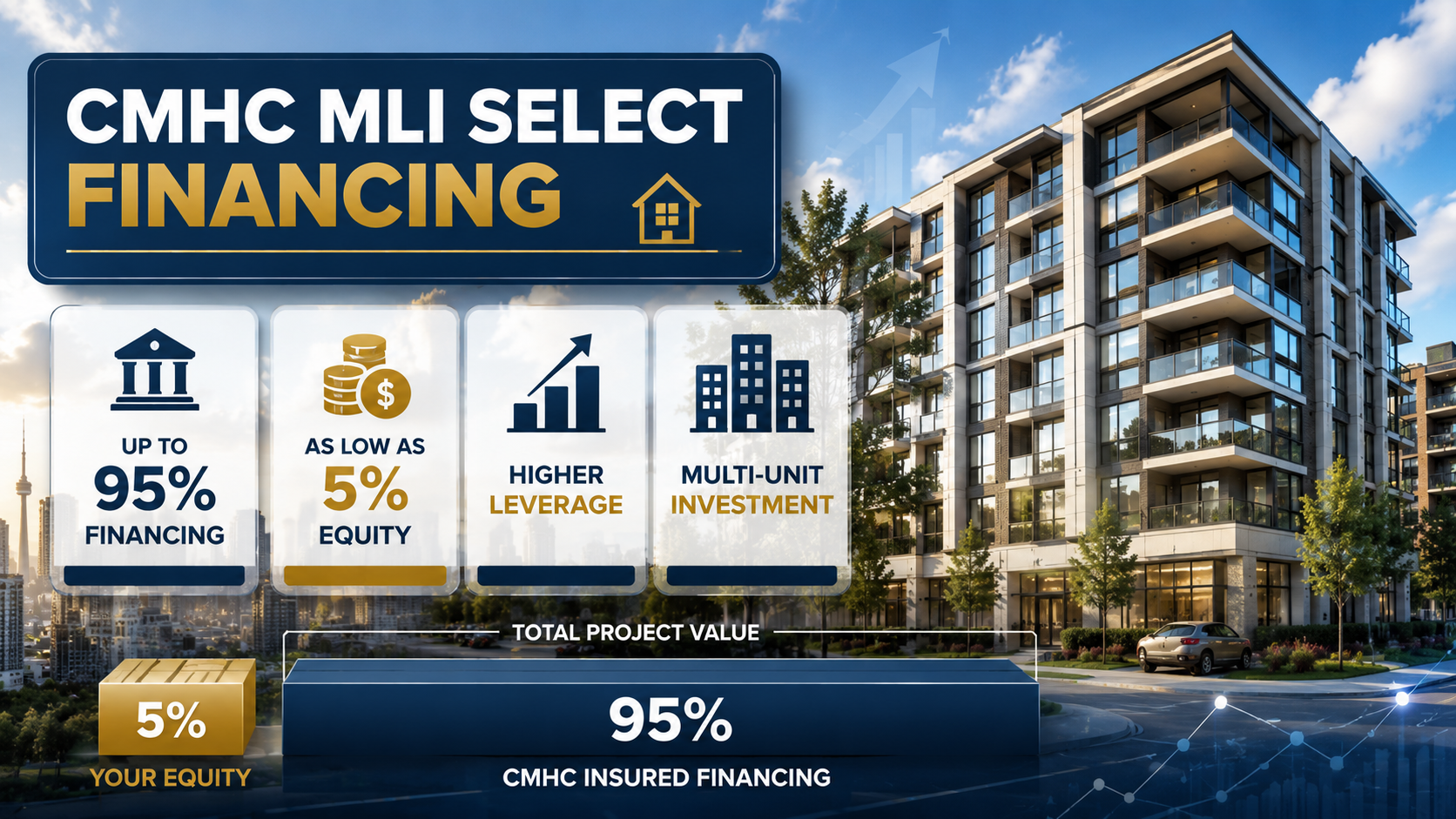
CMHC MLI Select changes the down payment equation structurally — not by subsidising the investor’s equity but by changing what the lender requires because the loan is now government-insured.
When CMHC insures a multi-unit loan under MLI Select, the lender’s risk profile changes significantly. The government backing means the lender can offer financing up to 95% of value or cost on qualifying projects. That ceiling — 95% LTV or LTC — is the number that most investors find difficult to believe the first time they hear it, because it is so far from the conventional commercial reality they are used to.
At 95% financing, the investor’s required equity drops to as low as 5% of project cost on the strongest qualifying files. That is not a marginal improvement over the conventional requirement. It is a structural transformation of how much capital you need to control an asset of a given size.
The practical effect on portfolio strategy is significant. The capital that would have been entirely consumed by one conventional deal — sitting in one asset, unavailable for anything else — can potentially be structured to cover multiple positions or deployed across a larger asset than you could otherwise access. MLI Select does not just lower the barrier to one deal. It changes the architecture of what a real estate portfolio can look like.
How Do Conventional Financing and MLI Select Compare Across All Key Equity and Leverage Metrics?
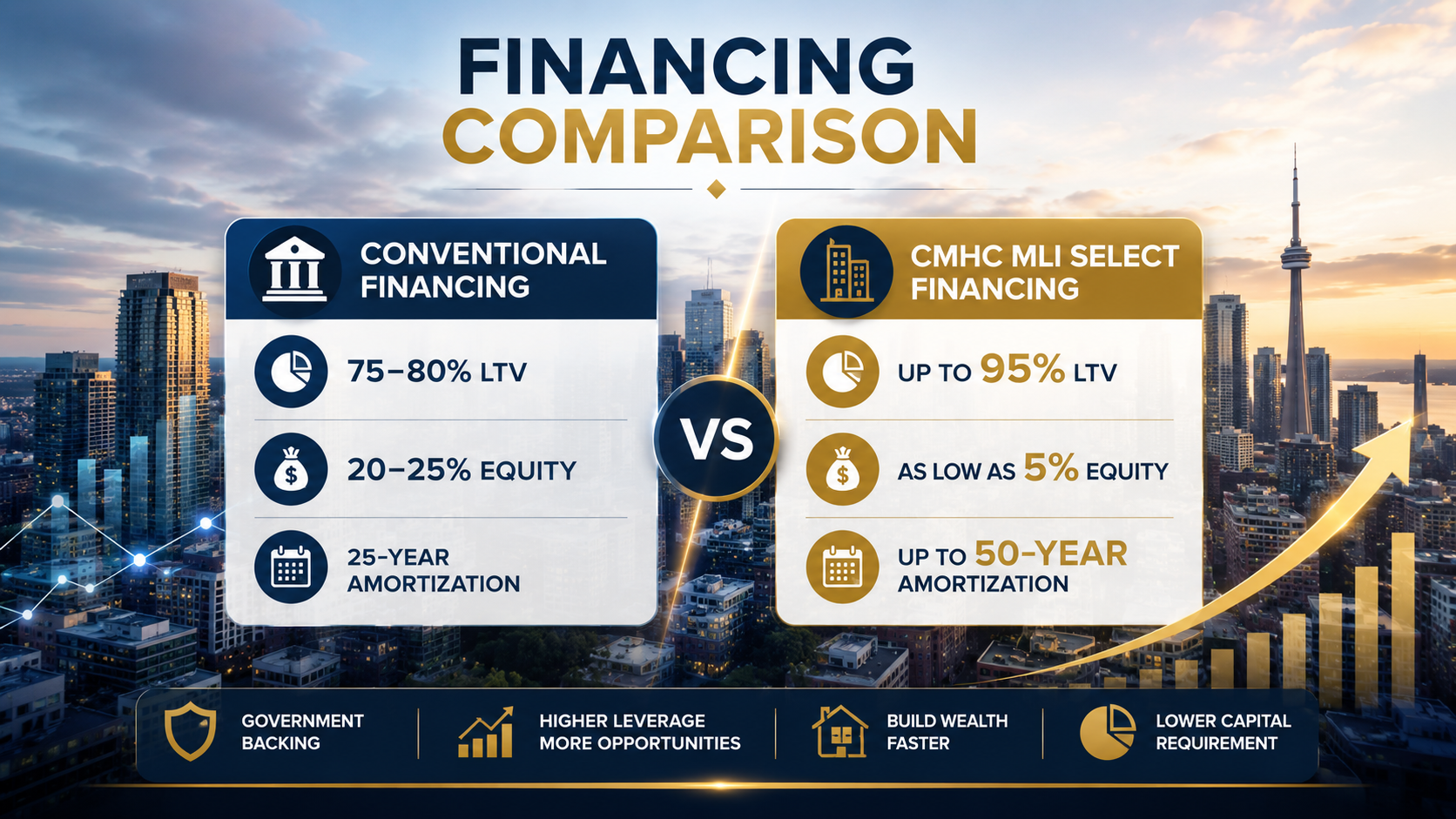
The contrast between conventional financing and MLI Select is clearest when you look at all the relevant metrics together — not just the down payment figure in isolation. Here is how the full picture compares across financing types:
| Financing Type | Max Loan-to-Value | Equity Required | Government Backing | Amortization |
|---|---|---|---|---|
| Conventional Commercial | 75–80% | 20–25% or more | None | Up to 25 years |
| Standard Insured (CMHC) | ~85% | ~15% | CMHC-Insured | Up to 25 years |
| MLI Select — Standard | Up to 95% | As low as 5% | CMHC-Insured | Up to 40 years |
| MLI Select — Enhanced | Up to 95% | As low as 5% | CMHC-Insured | Up to 45 years |
| MLI Select — Maximum | Up to 95% | As low as 5% | CMHC-Insured | Up to 50 years |
Note: The three MLI Select rows reflect the three point tiers — Standard (50+ points), Enhanced (70+ points) and Maximum (100+ points). All three tiers can reach 95% LTV on qualifying projects, but the amortization available increases as the point score rises. The financing type you access depends entirely on how well your project scores across the three MLI Select pillars.
🔗 External Source: CMHC MLI Select — Financing Terms and Program Overview
Why Is 'It Depends' the Honest Answer to the Down Payment Question — and What Does It Depend On?

The 5% figure is real — but it is the floor on the best qualifying files, not a universal guarantee. The actual equity required for your specific deal depends on several factors that interact with each other. Understanding these factors is what allows you to go into a deal with a realistic picture of what your capital commitment looks like.
| Factor | How It Affects Required Equity | Investor Takeaway |
|---|---|---|
| Point Score Tier | Higher score → higher LTV → lower equity needed | Maximise your score from the design stage onward |
| New Construction vs Existing | Construction (LTC) and acquisition (LTV) are assessed differently | Confirm which basis applies to your specific deal |
| Appraised Value | Loan is based on appraised value — not purchase price if lower | Appraisal before commitment protects your position |
| Debt Service Coverage | If income is tight, practical LTV may be lower than the 95% ceiling | Strong income projections supported by market rents |
| CMHC Premium & Surcharge | Usually rolled into the loan — affects total loan but not upfront equity | Model the net amount with your mortgage professional |
| Operating Reserves | Lenders expect adequate reserves — not part of the down payment itself | Budget separately for reserves beyond equity requirements |
The most important of these factors for most investors is the appraisal. The loan is always based on the lower of appraised value or purchase price. A project marketed at a given figure may appraise lower — and when it does, the investor is responsible for covering the gap between the appraised value and the purchase price, in addition to the required equity percentage. This is one of the most common sources of unexpected capital calls in multi-unit deals — and it is entirely avoidable if the appraisal happens before the investor commits their deposit rather than after.
Janak’s Insight
This is where most buyers get hurt. The biggest mistake is putting down a large deposit before you know whether the deal works — before the appraisal, before the financing picture is confirmed and before the point score has been verified as genuine. Janak Singh Chhabra flips the order: a fully-refundable deposit and a due-diligence window first, then the appraisal, then just 1% once the value checks out — with the balance only due closer to closing. Your capital is protected through the riskiest stage of the deal, not exposed to it.
What Other Costs Should Investors Budget for Beyond the MLI Select Down Payment?
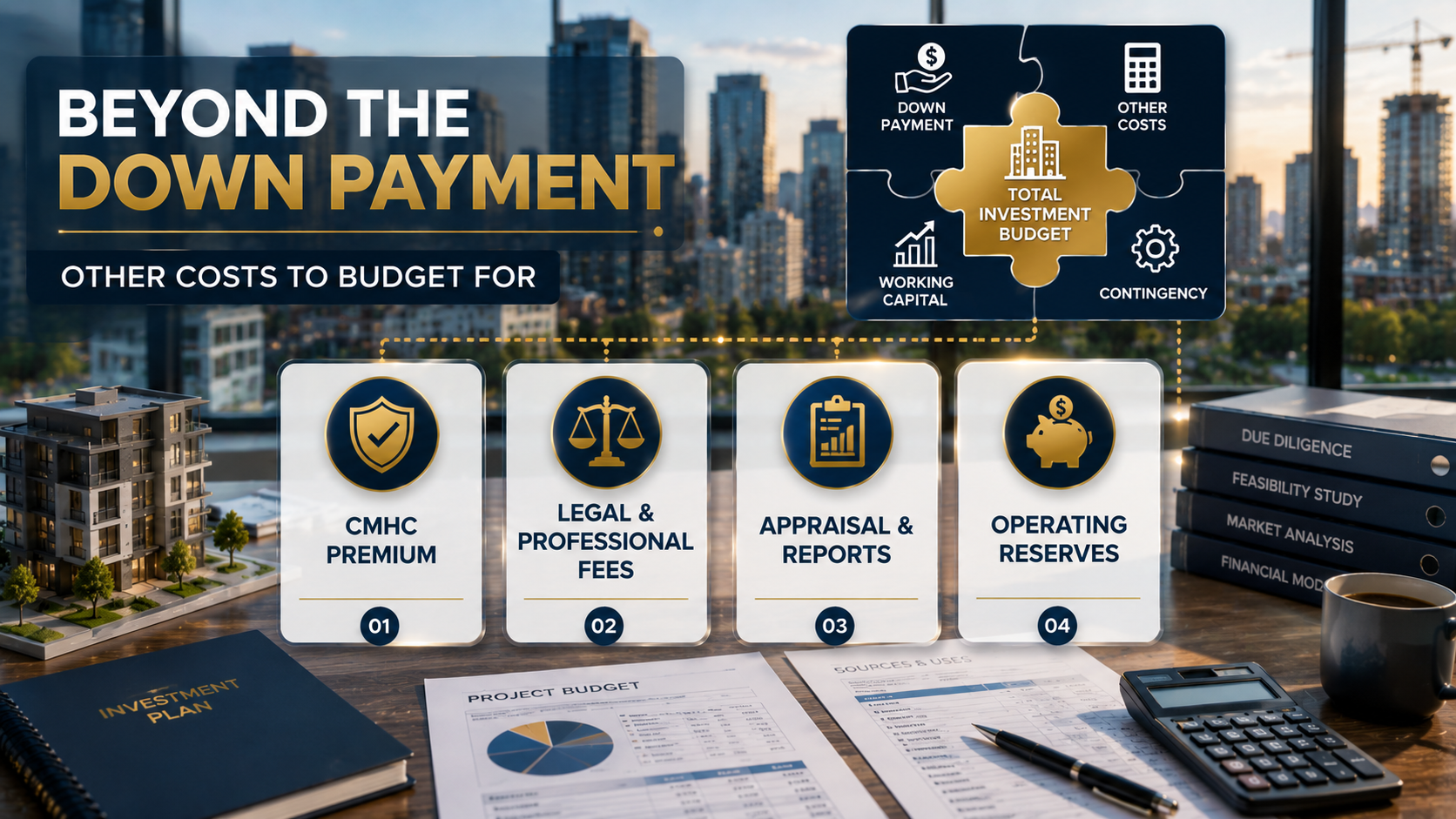
The equity requirement is the headline number — but a complete budget for an MLI Select deal includes several other cost categories that investors sometimes underestimate or discover late. Planning for these from the outset avoids surprises at closing.
CMHC Insurance Premium and Surcharge
CMHC mortgage insurance carries a premium calculated as a percentage of the insured loan amount. Under MLI Select, this premium is discounted based on your point tier — 10%, 20% or 30%. However, as of 2025, a surcharge applies for amortizations beyond 25 years — approximately 0.25% per five-year increment. The net premium is typically added to the loan balance rather than paid upfront, which means it does not directly increase your equity requirement — but it does affect the total loan amount and the long-term cost structure. Both the discount and the surcharge must be modelled together for an accurate picture.
Professional and Legal Fees
Energy modelling is required to document energy efficiency points and must be commissioned early in the design process. Appraisals are required before CMHC will insure the loan. Legal fees for purchase agreements, financing documentation and title transfer are standard costs of any real estate transaction. These are budgeted separately from the equity requirement.
Operating Reserves
Lenders expect investors to demonstrate adequate operating reserves — funds set aside to cover vacancies, unexpected maintenance and lease-up costs — beyond the equity deployed into the deal itself. These reserves are not part of the down payment but they are part of the total capital picture. A deal that consumes every available dollar in equity and leaves nothing for reserves is a deal that creates unnecessary risk from day one.
Why Is Understanding Leverage Just as Important as Understanding the Property Itself?

There is a mindset shift that separates investors who build meaningful multi-unit portfolios from those who stay at one or two properties for years without scaling — and it has nothing to do with intelligence or ambition. It has to do with how they think about leverage.
Most investors approach a deal by asking: how much is this property worth and can I afford it? That framing puts the focus on the asset and the capital required. The better framing — the one that MLI Select rewards — is: how much of this property’s value can I control with the least possible equity, and how does that structure affect both the cash flow and the next deal?
Two investors can purchase the same building. The one who structures it under MLI Select with maximum leverage and the longest available amortization walks away with lower monthly payments, better cash flow and more capital preserved for the next position. The other investor — working under conventional financing — has a larger equity stake in the same asset but less flexibility, tighter cash flow and no capital left for anything else.
The property is identical. The financial outcome over five or ten years is not. That gap is what understanding leverage through MLI Select actually means in practice.
What Is the Right Way to Approach the Down Payment Question Before You Commit to Any Deal?
The right approach is to get an accurate, deal-specific number before any significant capital is at risk — not after. The 5% figure is a genuine floor for the best qualifying projects under MLI Select. But the actual equity required for your deal depends on the point score, the appraisal outcome, the DSCR and the specific financing structure. Those figures need to be confirmed on the actual deal you are considering, not assumed from a general headline.
That confirmation is exactly what the due-diligence stage is for. And that due-diligence stage should happen before a meaningful deposit is at risk — not after.

Want to Know the Real Equity Requirement for Your Specific Deal?
Janak Singh Chhabra structures every MLI Select deal to protect your capital at each stage — starting with a refundable deposit, appraisal before you commit and only 1% down once the value checks out. He is paid only when your deal closes
mliselectprojects.ca · TFN Realty Inc., Brokerage · Maxwell Polaris, Brokerage
WHY INVESTORS WORK WITH JANAK SINGH CHHABRA
Avoid costly MLI Select mistakes.
MLI Select isn’t a program you want to learn on the job. The biggest mistakes often happen long before closing — during project selection, financing structure, appraisal review, and deposit planning. Janak Singh Chhabra specializes in MLI Select opportunities and helps investors navigate every stage with a process designed to protect capital and reduce risk.
Every recommendation is built around long-term cash flow, financing efficiency, and protecting the investor from common pitfalls that many buyers only discover after they have already committed funds.
INVESTOR-FIRST APPROACH
$5,000
Initial Fully-Refundable Deposit
1%
Due-Diligence & Verification Period
2 Weeks
Commission Paid Only At Final Closing
100%
Directional illustration only. Project-specific economics shared privately.
Frequently Asked Questions
Is the 5% down payment figure guaranteed on all MLI Select projects?
No. The 5% figure represents the equity floor on the strongest qualifying projects under MLI Select — those that reach the 95% loan-to-value ceiling with strong income support and a confirmed point score. The actual equity required on a specific deal depends on the project’s point tier, the appraised value relative to the purchase price, the debt service coverage and the lender’s underwriting assessment. Working with an advisor who runs deal-specific numbers is the only way to confirm what applies to your situation.
Can the CMHC insurance premium be paid upfront rather than rolled into the loan?
Yes — investors can choose to pay the premium upfront at closing rather than adding it to the loan balance. In practice, most investors roll it into the loan to preserve upfront capital, since the premium does not affect the equity calculation for qualification purposes. Whether to pay it upfront or roll it in is a decision best made in consultation with your mortgage professional based on your overall capital position and cash flow projections.
What happens if the property appraises below the purchase price?
If the appraised value comes in below the purchase price, the lender bases the loan on the lower figure. The investor is responsible for covering the gap between the appraised value and the purchase price in addition to the required equity percentage of the appraised value. This is one of the most common sources of unexpected capital calls in multi-unit deals and one of the strongest arguments for getting the appraisal done before committing a meaningful deposit — not after.
Does MLI Select allow for a vendor take-back or second mortgage to reduce the required equity?
MLI Select deals have specific rules about subordinate financing and vendor take-backs that affect how the loan-to-value is calculated. Whether a vendor take-back or secondary financing is permissible and how it affects the required equity depends on the specific structure of the deal and the lender’s underwriting requirements. This is a question to raise directly with a mortgage professional experienced in CMHC multi-unit financing.
How does MLI Select financing work for a construction project versus an existing building purchase?
For new construction, the loan is typically assessed against loan-to-cost rather than loan-to-value — meaning CMHC looks at the total cost of the project rather than the appraised value of a completed building. For an existing building purchase, the loan is assessed against the appraised value of the property as it stands. The distinction matters because construction cost budgets and appraised values can diverge — and because construction projects carry additional risk factors that the lender accounts for in underwriting.
Can I use gifted funds or borrowed equity to meet the MLI Select down payment requirement?
The source of the equity used to meet the down payment requirement — whether personal savings, gifted funds, home equity or other sources — is part of the lender’s underwriting assessment. CMHC and lenders have specific rules about acceptable equity sources for insured multi-unit loans. This is a detail to confirm with your mortgage professional before assuming that any particular source of funds will satisfy the requirement.
Does a higher point score always result in a lower required down payment?
A higher point score unlocks access to higher leverage — up to 95% LTV across all three tiers. So in that sense, yes — reaching any MLI Select tier gives you access to better leverage than conventional financing. However, the maximum 95% LTV is available across all three tiers on qualifying projects, not just the top tier. What changes with a higher score is primarily the amortization length and the premium discount — which affect monthly cash flow and long-term financing cost rather than the upfront equity percentage.
How does the Edmonton market affect the practical equity requirement compared to Ontario?
Edmonton’s lower acquisition costs mean that the same percentage equity requirement translates into a smaller absolute capital commitment than it would on a comparable Ontario property at a higher price. A 5% equity position on an Edmonton project represents a meaningfully lower absolute dollar amount than 5% on an equivalent GTA deal — which is one reason Ontario-based investors are increasingly accessing multi-unit exposure through Edmonton rather than trying to make the local Ontario numbers work at current prices.

Janak Singh Chhabra
A licensed Realtor at TFN Realty Inc., Brokerage – and one of the few specialists in Canada who works exclusively at the intersection of pre-construction real estate and CMHC MLI Select multi-unit investments. Janak is a two-time Diamond Award winner at Bay Street Group — one of the most recognized performance awards in Canadian real estate — for 2023 and 2024. The Diamond Award is given to top-performing realtors who demonstrate exceptional results across transaction volume, client satisfaction and professional excellence.