
What Is DSCR? The One Number That Decides If Your CMHC MLI Select Deal Gets Approved

Table of Contents
Why Does One Ratio Decide Whether Your Deal Lives or Dies?
Most new investors spend weeks studying the property — the location, the renovations, the rent roll. Then their financing falls apart over a number they’d never heard of.
That number is DSCR.
When a lender looks at a multi-unit rental, they aren’t asking “Is this a nice building?” They’re asking one blunt question: Does this property earn enough to pay its own mortgage? DSCR is how they answer it. Understand this single ratio and you’ll understand how lenders actually think — and why some deals get approved with very little money down while others get declined.
What Is DSCR (Debt Service Coverage Ratio)?
DSCR stands for Debt Service Coverage Ratio. It measures whether a property’s income is enough to cover its debt payments.
In plain terms, DSCR compares the money a property makes to the money it owes the lender each year. The higher the DSCR, the stronger the investment fundamentals — and the more comfortable a lender is financing it.
- A DSCR above 1.0 means the property earns more than its debt payments (positive coverage).
- A DSCR of exactly 1.0 means income and debt payments break even.
- A DSCR below 1.0 means the property doesn’t earn enough to cover its mortgage — a red flag for any lender.
DSCR is the financing world’s version of a credit score for the property itself, separate from your personal income.

How Is DSCR Calculated? (With a Simple Example)

Net Operating Income (NOI)
Net Operating Income (NOI) is the property’s income after operating expenses (property taxes, insurance, maintenance, management, utilities) but before the mortgage.
Annual Debt Service
Annual Debt Service is the total of all mortgage payments (principal + interest) over a year.
Say a small apartment building generates $120,000 in net operating income per year, and its annual mortgage payments total $100,000.
A DSCR of 1.20 means the property earns 20% more than it needs to cover its debt. Lenders read that as a healthy cushion.
Now imagine the same building with a mortgage that costs $115,000 a year.
Same building, same income — but a much thinner margin. This is why how you finance a property can matter as much as the property itself.
What Is a Good DSCR for a Rental Property?
There’s no universal number, but here are the general benchmarks lenders use in Canada:
- 1.20 and above — Strong. Conventional commercial lenders typically want to see this.
- 1.10 to 1.19 — Solid for government-backed programs like CMHC MLI Select.
- 1.00 to 1.09 — Tight. Limited financing options, higher scrutiny.
- Below 1.00 — The property can’t cover its own debt; financing is very difficult.
The key insight: the minimum DSCR a lender requires directly affects how much you can borrow. A lower required DSCR means a property can support a larger loan — which means a smaller down payment for you.
Why Is CMHC MLI Select's 1.10 DSCR Such a Big Deal?
Here’s where it gets interesting for investors.
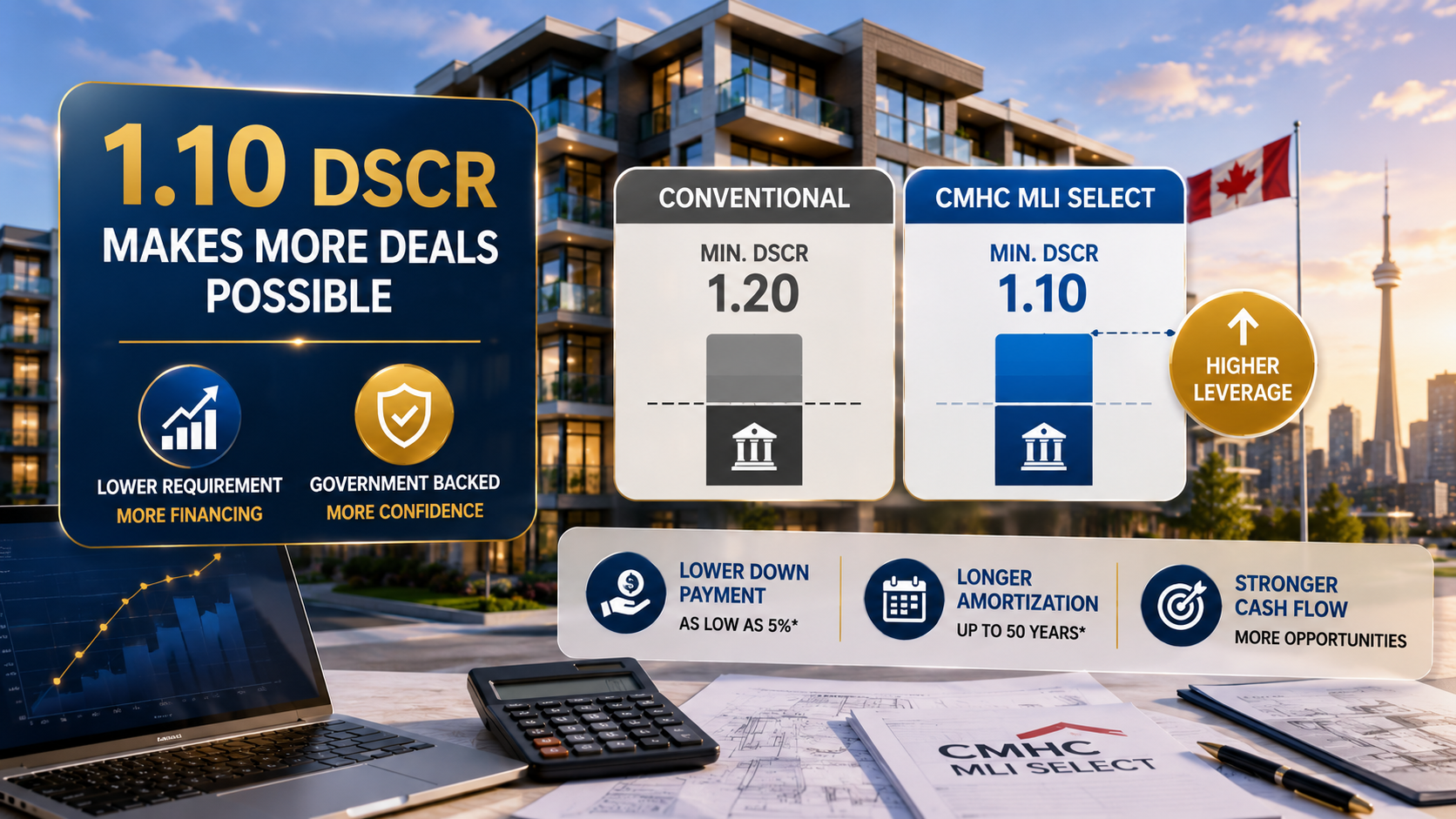
Conventional commercial financing usually requires a DSCR of around 1.20. CMHC MLI Select allows a DSCR as low as 1.10.
That gap looks small on paper, but it changes everything. Because the program accepts a thinner coverage requirement — backed by government mortgage insurance — a qualifying property can support more debt on the same income. More supportable debt means higher leverage and a lower down payment, often as little as 5% on qualifying projects.
In other words, the 1.10 DSCR is one of the quiet mechanics that makes MLI Select’s headline benefits — up to 95% financing and amortizations up to 50 years — mathematically possible. The longer amortization also helps: stretching payments over more years lowers your annual debt service, which raises your DSCR and makes more deals work.
This is why we focus on CMHC MLI Select opportunities with a DSCR of 1.10 or higher. A strong DSCR isn’t just a lending requirement — it’s a sign the investment fundamentals are sound from day one.
How Do You Improve a Property's DSCR?

If a deal’s DSCR is borderline, there are legitimate ways to strengthen it:
- Increase income — optimize rents to market, reduce vacancy, or add income sources (parking, storage, laundry).
- Reduce operating expenses — tighter management, energy efficiency, and better vendor contracts all lift NOI.
- Choose a longer amortization — spreading the loan over more years lowers annual debt service and improves DSCR (a key MLI Select advantage).
- Adjust the loan structure — the right financing program can change the math entirely.
The first two improve the property. The last two are about how the deal is structured — and that’s where working with an MLI Select specialist makes the difference.
The Mistake Investors Make When They Ignore DSCR
Too many investors fall in love with a building, sign before verifying the numbers, and only discover at the financing stage that the DSCR doesn’t support the loan they assumed. The deal shrinks, the required down payment balloons, and sometimes the whole thing collapses.
The investors who succeed do the opposite: they understand DSCR before they commit, and they only pursue projects where the fundamentals — and the financing — actually line up. DSCR isn’t paperwork to get through at the end. It’s a filter to use at the start.
Explore High-DSCR MLI Select Opportunities
If you’re investing in real estate, remember this one term — DSCR. It’s the number that quietly decides whether a deal works, and it’s at the heart of why CMHC MLI Select can outperform conventional financing.
We have multiple high-DSCR (1.10+) CMHC MLI Select investment projects available right now. To explore the right opportunity for your investment goals, call Janak Singh Chhabra today at 647-999-0935, or visit MLISelectProjects.ca.
mliselectprojects.ca · TFN Realty Inc., Brokerage · Maxwell Polaris, Brokerage
Frequently Asked Questions
What does DSCR stand for?
DSCR stands for Debt Service Coverage Ratio. It measures whether a property’s net operating income is enough to cover its annual debt payments.
What is the minimum DSCR for CMHC MLI Select?
CMHC MLI Select allows a DSCR as low as 1.10, compared to roughly 1.20 for conventional commercial financing. This lower requirement is part of why the program enables higher leverage and lower down payments.
How do you calculate DSCR?
Divide the property’s Net Operating Income (NOI) by its total annual debt service (mortgage principal + interest). A result above 1.0 means the property earns more than its debt costs.
Is a higher DSCR always better?
Generally, yes — a higher DSCR signals stronger fundamentals and a bigger cushion. But a very high required DSCR also limits how much you can borrow, so the goal is a healthy DSCR paired with efficient financing.
Does a longer amortization improve DSCR?
Yes. A longer amortization lowers your annual debt payments, which increases DSCR. This is one reason MLI Select’s amortizations of up to 50 years help more projects qualify.

Janak Singh Chhabra
A licensed Realtor at TFN Realty Inc., Brokerage – and one of the few specialists in Canada who works exclusively at the intersection of pre-construction real estate and CMHC MLI Select multi-unit investments. Janak is a two-time Diamond Award winner at Bay Street Group — one of the most recognized performance awards in Canadian real estate — for 2023 and 2024. The Diamond Award is given to top-performing realtors who demonstrate exceptional results across transaction volume, client satisfaction and professional excellence.
This article is for general educational purposes and is not financial, mortgage, or investment advice. CMHC program terms, DSCR requirements, and mortgage rates can change — confirm current details with a qualified professional. Independent platform · Not affiliated with any government agency.